Former Lebanese Minister Wiam Wahhab: If NATO Intervenes in Syria, Hizbullah and Syria Will Fire 100,000 Rockets at Israel - Al-Jadid/New TV (Lebanon) - July 9, 2011
Showing posts with label Hezbollah. Show all posts
Showing posts with label Hezbollah. Show all posts
(BLOG) CBC Investigation: Who Killed Lebanon's Rafik Hariri?
Video below: "It wasn't until late 2007 that the awkwardly titled UN International Independent Investigation Commission actually got around to some serious investigating.
By then, nearly three years had passed since the spectacular public murder of Lebanon's former prime minister Rafik Hariri.
Hariri, the builder. The billionaire tycoon who'd reclaimed Beirut's architectural heritage from the shattered cityscape of a civil war and made it his mission to restore Lebanon's mercantile leadership.
Hariri, the nationalist who'd had the courage to stand against Syria, Lebanon's long-time occupier; and in his day was the most important reformer in the Middle East.
The massive detonation that killed him on Feb. 14, 2005 unleashed forces no one knew were there. All of Lebanon seemed to rise up in the murder's aftermath, furiously pointing at the country's Syrian overlords.
 The not unreasonable assumption was that Hariri had died for opposing Damascus.
Lebanon's fury quickly accomplished what the assassinated leader had failed to achieve in his lifetime.
The murder gave rise to the so-called Cedar Revolution, a rare Lebanese political consensus. Syria, cowed by the collective anger, withdrew its troops.
At the UN, France and the U.S. pushed the Security Council into dispatching a special investigative commission.
For a time, it actually seemed that Lebanon was moving toward the rule of law and true democracy.
But, by the end of 2007, all that had ebbed. The killers remained uncaught. Syria was gradually reasserting its influence. And assassinations of other prominent Lebanese continued.
In the White House, senior administration officials began to conclude that the UN's famous clay feet were plodding toward nothing.
It turned out they were right.
A months-long CBC investigation, relying on interviews with multiple sources from inside the UN inquiry and some of the commission's own records, found examples of timidity, bureaucratic inertia and incompetence bordering on gross negligence.
Among other things, CBC News has learned that:
 Part 1: Connecting The Cellphones
In its first months, the UN inquiry had actually appeared promising. The first commissioner, a German judge named Detlev Mehlis, quickly delivered a blistering report suggesting Syria had ordered, if not actually carried out, the hit.
Unspecified agents, Mehlis contended, had done the deed.
But Mehlis's successor, a Belgian prosecutor named Serge Brammertz, seemed to be more interested in avoiding controversy than in pursuing any sort of serious investigation, at least according to people who worked for him.
Under his leadership, the commission spent most of its time chasing what turned out to be false leads and disproving wild conspiracy theories.
That isn't to say the commission didn't have some good investigators. It did. In fact, it had a handful of the best that Western police agencies had to offer.
But Brammertz could not be persuaded to authorize the one technique that those investigators wanted above all to deploy: telecommunications analysis, probably the single most important intelligence-gathering tool in modern times.
Telecommunications analysts use powerful computers and highly sophisticated software to sift through millions of phone calls, seeking patterns, referencing and cross-referencing, identifying networks and associations.
Police forces call it 'telecomms.' Spy agencies call it 'sigint.' It leads to convictions in courts and missile strikes in places like Afghanistan and Yemen.
Unbelievably, though, the UN commission in Lebanon did no telecom analysis at all for most of its first three years of existence. It wasn't until Brammertz was nearing the end of his term that one particularly dogged detective prodded him into letting the inquiry start examining phone records.
 The breakthrough
At that point, in October of 2007, things began moving fast. Commission staff actually managed to obtain the records of every single phone call made in Lebanon the year of Hariri's murder — a stunning amount of data — and brought in a British firm called FTS to carry out the specialized analysis.
UN clerks worked day and night inputting data into a program called IBase. Then, in December, a specialist from FTS began examining what the computer was spitting out.
Within two days, he called the UN investigators together. He had identified a small network of mobile phones, eight in all, that had been shadowing Hariri in the weeks prior to his death.
It was the single biggest breakthrough the commission had accomplished since its formation — 'earth-shattering,' in the words of one of the people in the room the day the network was identified.
What the British analyst showed them was nothing less than the hit squad that had carried out the murder, or at least the phones they'd been carrying at the time.
For the first time, commission investigators were staring at their quarry. The trouble was, the traces were now nearly three years old, long past the 'golden hour' for harvesting the best clues.
Still, it was something. And when the investigators began their due diligence, double-checking their work, there was another revelation, this one even more earth-shattering.
Someone digging though the commission's records turned up a report from a mid-ranking Lebanese policeman that had been sent over to the UN offices nearly a year and a half earlier, in the first months of 2006.
Not only had the policeman identified what the UN would eventually dub the 'red network' — the hit team — he had discovered much more. He had found the networks behind the networks.
In fact, he'd uncovered a complex, disciplined plot that had been at least a year in the planning, and he had already questioned suspects.
What's more, everything he'd discovered pointed to one culprit: Hezbollah, the Party of God.
All of this was in the policeman's report, which he had dutifully sent to the UN officials with whom he was supposed to be partnering.
And the UN commission had promptly lost it.
 Part 2: Death of a true patriot
Before his violent death in 2008, Wissam Eid was an unusual figure in the murky, often corrupt world of Arab policing.
He had never actually wanted to be a policeman, or an intelligence officer. In authoritarian Arab society, he had no interest in becoming an authority figure. And yet, he'd had no choice.
When he was doing his military service in the 1990s, the ISF, Lebanon's all-encompassing security force, noticed Eid's degree in computer engineering.
The security service was then trying to build an information technology department. And that was that.
'He was a patriot,' says his father Mahmoud, sitting in the living room of the family home in Deir Ammar, on the outskirts of Tripoli.
The centerpiece of the room is, in the Arab way, a shrine to their son. The young man's intense, chiselled countenance stares back at visitors over commendations and testimonials.
His mother Samira, a picture of Islamic dignity, is a religious person. It helps with the grief.
The rest of her family is not particularly observant. But they all understand the savage realities of their country and how those realities clashed with Eid's unyielding pursuit of some of the most dangerous people in the world.
By the time Hariri was killed in 2005, Eid was a captain in the ISF. His boss, Lt.-Col. Samer Shehadeh, brought him into the investigation.
It was a Lebanese investigation, Eid was told, but it was also a UN one. Eid was to co-operate with the foreigners working out of the old abandoned hotel in the hills above Beirut.
Process of elimination
Capt. Eid, though, wasn't interested in delving into some of the wilder theories making the rounds in Lebanon.
He reasoned that finding the first traces of the killers was a process of elimination.
From Lebanon's phone companies, he obtained the call records of all the cellphones that had registered with the cell towers in the immediate vicinity of the Hotel St. George, where the massive blast had torn a deep crater.
Once Eid had those records, he began thinning out the hundreds of phones in the area that morning, subtracting those held by each of the 22 dead, then those in Hariri's entourage, then those of people nearby who had been interviewed and had alibis.
Soon enough, he had found the 'red' phones the hit team had used.
But he didn't stop there. Exhaustively tracking which towers the red phones had 'shaken hands with' in the days before the assassination, and comparing those records to Hariri's schedule, he discovered that this network had been shadowing the former PM.
The red-phone carriers were clearly a disciplined group. They communicated with one another and almost never with an outside phone. And directly after the assassination, the red network went dead forever.
But Eid had found another connection. He eventually identified eight other phones that had for months simultaneously used the same cell towers as the red phones.
Signals intelligence professionals call these 'co-location' phones.
What Capt. Eid had discovered was that everyone on the hit team had carried a second phone, and that the team members had used their second phones to communicate with a much larger support network that had been in existence for at least a year.
Eventually, the UN would label that group the 'blue' network.
 More networks
The blue network also exercised considerable discipline. It, too, remained a 'closed' network. Not once did any blue-network member make the sort of slip that telecom sleuths look for.
But these people also carried co-location phones and Eid kept following the ever-widening trail of crumbs.
The big break came when the blue network was closed down and the phones were collected by a minor electronics specialist who worked for Hezbollah, Abd al Majid al Ghamloush.
Ghamloush was, in the words of one former UN investigator, 'an idiot.'
Given the job of collecting and disposing of the blue phones, he noticed some still had time remaining on them and used one to call his girlfriend, Sawan, in the process basically identifying himself to Capt. Eid. He might as well have written his name on a whiteboard and held it up outside ISF headquarters.
Ghamloush's stupidity eventually led Eid to a pair of brothers named Hussein and Mouin Khreis, both Hezbollah operatives. One of them had actually been at the site of the blast.
Capt. Eid kept going, identifying more and more phones directly or indirectly associated with the hit team. He found the core of a third network, a longer-term surveillance team that would eventually be dubbed the 'yellows.'
Eid's work would also lead to another discovery: Everything connected, however elliptically, to land lines inside Hezbollah's Great Prophet Hospital in South Beirut, a sector of the city entirely controlled by the Party of God.
 It has long been said that the fundamentalist fighters operate a command centre in the hospital.
Eventually, telecom sleuths would identify another network of four so-called 'pink phones' that had been communicating both with the hospital and, indirectly, with the other networks.
These phones turned out to be tremendously important. It turned out they had been issued by the Lebanese government itself and when the ministry of communications was queried about who they had been issued to, the answer came back in the form of a bland government record.
CBC has obtained a copy of this record provided to the commission. On it, someone has highlighted four entries in a long column of six-digit numbers. Beside the highlighted numbers, in Arabic, was the word 'Hezbollah.'
Hezbollah has several seats in the Lebanese legislature and at the time had been part of a governing coalition, hence the government-issued phones.
Finally, Eid was handed a clue from the best source possible: He was contacted by Hezbollah itself and told that some of the phones he was chasing were being used by Hezbollah agents conducting a counter-espionage operation against Israel's Mossad spy agency and that he needed to back off.
The warning could not have been more clear.
As though to underscore it, Eid's boss, Lt.-Col. Shehadeh, was targeted by bombers in September 2006. The blast killed four of his bodyguards and nearly killed Shehadeh, who was sent to Quebec for medical treatment and resettlement.
By that time, Capt. Eid had sent his report to the UN inquiry and moved on to another operation.
The Eid report was entered into the UN's database by someone who either didn't understand it or didn't care enough to bring it forward. It disappeared.
 Mixed with shame
A year and a half later, in December 2007, when the Eid report finally resurfaced, the immediate reaction of the UN telecom team was embarrassment. And then suspicion.
Eid claimed to have performed his analysis using nothing but Excel spreadsheets and that, said the British specialist, was impossible.
No one, he declared, could accomplish such a thing without powerful computer assistance and the requisite training. No amateur, which is how the specialists regarded Eid, could possibly have waded through the millions of possible permutations posed by the phone records and extracted individual networks.
This Capt. Eid must have had help, thought the telecom experts. Someone must have given him this information. Perhaps he was involved somehow?
By now it was January 2008. A new UN commissioner was in charge, a Canadian justice official named Daniel Bellemare. Investigators were finally beginning to believe they were getting somewhere.
A deputation of telecom experts was dispatched to meet Eid. They questioned him and returned convinced that, somehow, he had indeed identified the networks himself.
Eid appeared to be one of those people who could intuit mathematical patterns, the sort who thinks several moves ahead in chess. Even better, he was willing to help directly. He wanted Hariri's killers to face justice, Hezbollah's warning be damned.
It was an exciting prospect for the UN team. Here was an actual Lebanese investigator, with insights and contacts the UN foreigners could never match.
A week later, a larger UN team met with Capt. Eid and, again, all went well.
Then, the next day, Jan. 25, 2008, eight days after his first meeting with the UN investigators, Capt. Wissam Eid met precisely the same fate as Hariri. The bomb that ripped apart his four-wheel-drive vehicle also killed his bodyguard and three innocent bystanders.
Lebanon gave Eid a televised funeral and, at the UN inquiry, there was outrage as well. But mixed with shame.
Because there was no doubt in the mind of any member of the telecom team why Eid had died: Hezbollah, they deduced, had found out that Capt. Eid's report had been discovered, that he'd met with the UN investigators and that he had agreed to work with them.
Immediately, the telecom team had the records of the cell towers near the Eid blast site collected, reasoning the killers might once again have left digital footprints they could follow.
Not this time, though. There was nothing. This time the killers did what they should have been doing all along: They'd used radios, not cellphones. Radios don't leave a trace.
That left the UN team with the obvious problem. Their adversary obviously knew not only what the UN investigators were doing, but knew in considerable detail.
And the more the UN investigators thought about it, the more they focused on one man: Col. Wissam al Hassan, the new head of Lebanese intelligence.
 Part 3: An unexplained alibi
In the tradition of Middle Eastern intelligence chiefs, Col. Hassan is a puzzling, even feared figure in his own country.
He was on the UN radar from the beginning, for two reasons: He quickly became one of the inquiry's main liaisons with the ISF; plus he was in charge of Hariri's security at the time of the assassination.
Except he hadn't been in the convoy the day of the blast. And his alibi was flimsy, to put it mildly.
On July 9, 2005, Col. Hassan told UN investigators that he was enrolled in a computer course, Management Social et Humaine, at Lebanese University.
He said that on the day before the assassination, Feb. 13, he had received a call from his professor, Yahya Rabih, informing him he was required to sit for an exam the next day.
Twenty minutes later, he told investigators, Hariri had phoned, summoning him. Col. Hassan said he arrived at Hariri's residence at 9:30 that evening and obtained his boss's permission to attend the exam the next day.
He spent the entire next morning studying for the exam, he told the UN, and turned off his phone when he entered the university, which was at just about the time Hariri died.
'If I wasn't sitting for that exam,' Hassan told investigators, 'I would have been with Mr. Hariri' when he died.
A different story
But Hassan's phone records told another story entirely.
In fact, it was Col. Hassan who called the professor, not the other way around. And Hassan placed the call half an hour after he had met Hariri earlier in the evening.
The cell towers around Hassan's home also showed that the next day Col. Hassan spent the hours before Hariri's assassination, the time he was supposedly studying, on the phone.
He made 24 calls, an average of one every nine minutes.
What was also disturbing the UN investigators was that high security officials in Lebanon don't normally sit for exams.
'His alibi is weak and inconsistent,' says a confidential UN report that labels Hassan a 'possible suspect in the Hariri murder.'
That report, obtained by CBC News, was prepared in late 2008 for Garry Loeppky, a former senior RCMP official who had taken over as the UN's chief investigator that summer.
Hassan's alibi, said the document, 'does not appear to have been independently verified.'
That hadn't been for lack of desire on the part of UN investigators. They'd wanted to check out Hassan's alibi, to 'get in his face,' in the words of one former detective, and pick apart his story.
At the very least, they wanted to contact Rabih, the professor.
But Brammertz, the second UN commissioner, flatly ruled that out. He considered Hassan too valuable a contact and any such investigation as too disruptive.
 'Might damage relations'
The confidential report concedes that investigating Hassan could have its drawbacks: 'It may damage the commission's relations with the ISF, and if he was somehow involved in the Hariri murder, the network might resolve to eliminate him.'
Nonetheless, the report states that Col. Hassan 'is a key interlocutor for the commission. He is in a unique position to influence our investigation. As such, questions regarding his loyalty and intentions should be resolved.
'Therefore, it is recommended that WAH be investigated quietly.'
But even that wasn't done. The UN commission's management ignored the recommendation.
Former UN investigators remain suspicious to this day of Hassan, who, they note, was eventually cut out of the inquiry's loop.
But Hassan did become Capt. Eid's boss after the Hariri assassination. He certainly would have known about the sudden interest in the Eid report, and the meetings.
'He was an unsavory character,' a former senior UN official said. 'I don't think he participated in the murder, but there's no way of telling what he knew.'
'He rose, at the very least, to the level of a person of interest,' said another.
Reached in Lebanon today, al Hassan repeatedly declined comment.
 More calls
Though told to back off, UN investigators nevertheless had managed to collect Hassan's phone records for late 2004 and all of 2005.
In that time, he had 279 discussions with Hussein Khalil, the principal deputy of Hezbollah chieftain Hassan Nasrallah. Khalil in turn spoke 602 times to Wafik Safa, who is known in intelligence circles as the hard man who runs Hezbollah's internal security department.
No one asked Hassan about those calls, either.
Hassan, though, also has his defenders. He remains a close ally of Hariri's son Saad, the current Lebanese prime minister.
Also, former U.S. officials, some of whom were in the Oval Office when then president George W. Bush vented his frustration with the commission's apparent incompetence, maintain that Hassan is in fact a bitter enemy of Hezbollah, and casting suspicion on him merely plays into the group's hands.
That this particular UN memo about Hassan was ever written, says one former American security official, is evidence that the commission hadn't the slightest idea what it was doing.
Several former UN investigators, though, are unanimous. They believe Hezbollah infiltrated the commission and used Hassan in the process.
'He lied to us on the alibi,' says one. 'He should have died in the convoy. That's the question mark.'
 Part 4: Naming names?
Nearly six years have now passed since Hariri's assassination. The UN mandate was eventually expanded to include nine untargeted public bombings and 11 targeted attacks and assassinations, including that of Capt. Eid.
Daniel Bellemare oversaw the commission's transformation into the Special Tribunal for Lebanon, residing in The Hague, and is now its chief prosecutor.
To date, the UN inquiry has reportedly spent in the range of $200 million and there has been talk for some time now that it is preparing to bring down indictments, possibly late this year or in early 2011.
The tribunal currently has an annual budget in excess of $40 million and more than 300 employees from 61 countries. It has a headquarters, a team of prosecutors, a defence office, judges, clerks, investigators and research staff, even access to detention facilities, but not a single accused.
Bellemare is singularly uncommunicative about whatever progress has been made, as was Brammertz. From time to time, Bellemare has assured the Lebanese media that justice is proceeding, must remain confidential and shouldn't be rushed.
Bellemare refused repeated requests to speak to CBC News about this report.
The commission's telecom team eventually produced a succession of sophisticated charts depicting the phone networks behind the Hariri killing. CBC News has obtained a fairly recent iteration.
In recent months, investigators even attached names to some of the red phones carried by the Hariri hit squad.
But the biggest problem, according to several sources, has been converting the telecommunications analysis into evidence that will stand up in a court of law.
That means someone has to find financial records, or witnesses or other evidence, to actually place the phones in the hands of the alleged perpetrators.
As of mid-2009, sources say, the commission had not done so.
'There was no [corroborating] evidence whatsoever,' says one former insider. 'And there was no hope of getting any evidence. Because who are you going to put on the ground in southern Beirut to go digging around? You can't put anyone on the ground. It's not possible.'
What's more, the commission never used wiretaps, even after it identified certain phones in networks that hadn't gone dead.
In all likelihood, any formal request to the Lebanese authorities for a phone tap would have become known in short order to Hezbollah, given its connections. And Bellemare wouldn't allow his investigators to buy and use eavesdropping technology on their own.
He had, though, gone cap-in-hand to Washington, looking for help from its intelligence agencies. There, he met with Bush's national security adviser, Stephen Hadley, and with then secretary of state Condoleezza Rice.
But he was rebuffed. Bellemare had not been Washington's choice for the job and U.S. officials did not hold him in terribly high regard. They were aware he had been spending much of his time obsessing over the trappings of his UN offices, ordering in tailored clothes, boasting about his prosecutorial prowess and designing a personal coat of arms.
His underlings had watched, bemused, as he dispatched security staff to Beirut's more fashionable shopping districts to inquire about having the family crest embossed on pieces of jewelry.
'If I was given to conspiracy theories,' said one of Bellemare's former officials, 'I'd think he was deliberately put in there so as not to achieve anything.'
Secret intercepts from intelligence agencies like the CIA or National Security Agency are not useable in a court such as the UN Special Tribunal. And, knowing of the leaks and other problems at the UN commission, no intelligence agency in the West was prepared to hand over such sensitive material.
 When Hadley politely inquired as to what Bellemare would consider a success — indictments, actual arrests, declarations of official suspicions? — the Canadian waffled, unable or unwilling to provide a precise answer.
Meanwhile, back in Lebanon, Hezbollah had begun mounting a campaign to ensure that gathering supporting evidence would remain next to impossible.
As rumours began surfacing in the Lebanese press that the UN tribunal was getting close to issuing indictments, Nasrallah, the Hezbollah chief, began warning that he will simply not tolerate arrests of any of his people.
That's no idle threat. Nasrallah operates a private militia considerably more powerful than the Lebanese army. And he also demanded that the UN tribunal, which is partially funded by Lebanon, be dissolved.
In recent months, Nasrallah has taken to claiming that it was actually Israel that killed Hariri.
More than one former UN investigator believes that should the telecommunications evidence ever be put before the Lebanese public, Nasrallah will acknowledge that his operatives were on the street when Hariri died, but claim that they were there chasing Israeli assassins.
Nothing the UN has uncovered points remotely at Israel. Everything points at Hezbollah. But invoking Israel always gains traction in the Arab world.
Backing off
One formerly senior official with the commission says 'considerable progress' was made during the most recent months of Bellemare's term in gathering evidence to support the telecommunications work. But, he concedes, the evidence is still largely circumstantial.
That may be all the excuse that Prime Minister Saad Hariri and his political allies need to let this commission die.
Saad Hariri and his supporters originally blamed Syria for the assassination. But they've been backpedaling in recent months. Hariri recently exonerated Syria, repudiating his own sworn statement to UN investigators in 2005.
He has also called for an investigation of Nasrallah's claims that Israel killed his father.
Detlev Mehlis, the first UN commissioner, told CBC News recently that it has always been obvious Syria ordered the Hariri hit. That it would use Hezbollah, its long-time proxy, he says, is only logical.
The elder Hariri, Mehlis noted, had pushed not just for a Syrian withdrawal but also for the disarming of Hezbollah's feared militia.
Scott Carpenter, a former Bush administration official dispatched by the White House to Lebanon in the wake of Hariri's death, also says the reality is obvious.
But, he adds: 'Is Hezbollah going to get away with it? Yes. Fewer travesties will be greater, but I don't see where the international will is to take this on, and I certainly don't see, absent that international will, how the Lebanese people can take it on.'
 A martyr remembered
Capt. Eid, who was posthumously promoted to the rank of major, lies in a grave not far from the family home in Deir Ammar.
His picture is everywhere in the city, looking down upon streets, cafes and restaurants. He is uniformly described as a martyr to his country.
His family has precious little by which to remember him. A few photos, a scrapbook of news stories about his death, and a few minutes of amateur video.
Mohammed Eid says that by late 2007, his older brother had begun living in his office, convinced he probably didn't have much longer to live.
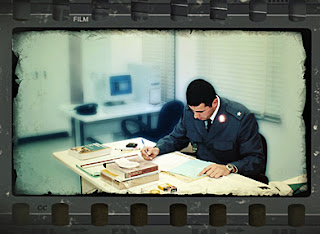
He asked Mohammed to make the video, which depicts him working at his desk in the ISF's Beirut headquarters. In it, he banters with people off-screen; it is unremarkable footage, but haunting to anyone who knows his story.
Eid's mother, Samira, says her son was a gift to their country and believes that, as a martyr, he remains with her eternally.
'If we have a few other Wissams in Lebanon, the country will be just fine,' she says. Her husband just stares sadly into space.
She and her husband and their three surviving sons know almost certainly who killed Wissam.
But this is Lebanon, and they understand the consequences of talking about that.
'I cannot open my mouth,' she says, 'because we have other young men to protect.'
Mohammed Eid says the family has even come to realize that Lebanon could pay a bloody price if his brother's murderers are ever charged. 'C'est pas le moment,' he says, in the family's second language.
But of his brother's investigative skill, the family has no doubt.
In 2009, before the UN inquiry packed up and left for The Hague, an Australian prosecutor named Raelene Sharp, who'd been working for the commission, paid the Eid family a surprise visit.
She wept, as she told them that without their son, the commission would be nowhere." (source)
Related Article:
By then, nearly three years had passed since the spectacular public murder of Lebanon's former prime minister Rafik Hariri.
Hariri, the builder. The billionaire tycoon who'd reclaimed Beirut's architectural heritage from the shattered cityscape of a civil war and made it his mission to restore Lebanon's mercantile leadership.
Hariri, the nationalist who'd had the courage to stand against Syria, Lebanon's long-time occupier; and in his day was the most important reformer in the Middle East.
The massive detonation that killed him on Feb. 14, 2005 unleashed forces no one knew were there. All of Lebanon seemed to rise up in the murder's aftermath, furiously pointing at the country's Syrian overlords.

Lebanon's fury quickly accomplished what the assassinated leader had failed to achieve in his lifetime.
The murder gave rise to the so-called Cedar Revolution, a rare Lebanese political consensus. Syria, cowed by the collective anger, withdrew its troops.
At the UN, France and the U.S. pushed the Security Council into dispatching a special investigative commission.
For a time, it actually seemed that Lebanon was moving toward the rule of law and true democracy.
But, by the end of 2007, all that had ebbed. The killers remained uncaught. Syria was gradually reasserting its influence. And assassinations of other prominent Lebanese continued.
In the White House, senior administration officials began to conclude that the UN's famous clay feet were plodding toward nothing.
It turned out they were right.
A months-long CBC investigation, relying on interviews with multiple sources from inside the UN inquiry and some of the commission's own records, found examples of timidity, bureaucratic inertia and incompetence bordering on gross negligence.
Among other things, CBC News has learned that:
- Evidence gathered by Lebanese police and, much later, the UN, points overwhelmingly to the fact that the assassins were from Hezbollah, the militant Party of God that is largely sponsored by Syria and Iran. CBC News has obtained cellphone and other telecommunications evidence that is at the core of the case.
- UN investigators came to believe their inquiry was penetrated early by Hezbollah and that that the commission's lax security likely led to the murder of a young, dedicated Lebanese policeman who had largely cracked the case on his own and was co-operating with the international inquiry.
- UN commission insiders also suspected Hariri's own chief of protocol at the time, a man who now heads Lebanon's intelligence service, of colluding with Hezbollah. But those suspicions, laid out in an extensive internal memo, were not pursued, basically for diplomatic reasons.

In its first months, the UN inquiry had actually appeared promising. The first commissioner, a German judge named Detlev Mehlis, quickly delivered a blistering report suggesting Syria had ordered, if not actually carried out, the hit.
Unspecified agents, Mehlis contended, had done the deed.
But Mehlis's successor, a Belgian prosecutor named Serge Brammertz, seemed to be more interested in avoiding controversy than in pursuing any sort of serious investigation, at least according to people who worked for him.
Under his leadership, the commission spent most of its time chasing what turned out to be false leads and disproving wild conspiracy theories.
That isn't to say the commission didn't have some good investigators. It did. In fact, it had a handful of the best that Western police agencies had to offer.
But Brammertz could not be persuaded to authorize the one technique that those investigators wanted above all to deploy: telecommunications analysis, probably the single most important intelligence-gathering tool in modern times.
Telecommunications analysts use powerful computers and highly sophisticated software to sift through millions of phone calls, seeking patterns, referencing and cross-referencing, identifying networks and associations.
Police forces call it 'telecomms.' Spy agencies call it 'sigint.' It leads to convictions in courts and missile strikes in places like Afghanistan and Yemen.
Unbelievably, though, the UN commission in Lebanon did no telecom analysis at all for most of its first three years of existence. It wasn't until Brammertz was nearing the end of his term that one particularly dogged detective prodded him into letting the inquiry start examining phone records.

At that point, in October of 2007, things began moving fast. Commission staff actually managed to obtain the records of every single phone call made in Lebanon the year of Hariri's murder — a stunning amount of data — and brought in a British firm called FTS to carry out the specialized analysis.
UN clerks worked day and night inputting data into a program called IBase. Then, in December, a specialist from FTS began examining what the computer was spitting out.
Within two days, he called the UN investigators together. He had identified a small network of mobile phones, eight in all, that had been shadowing Hariri in the weeks prior to his death.
It was the single biggest breakthrough the commission had accomplished since its formation — 'earth-shattering,' in the words of one of the people in the room the day the network was identified.
What the British analyst showed them was nothing less than the hit squad that had carried out the murder, or at least the phones they'd been carrying at the time.
For the first time, commission investigators were staring at their quarry. The trouble was, the traces were now nearly three years old, long past the 'golden hour' for harvesting the best clues.
Still, it was something. And when the investigators began their due diligence, double-checking their work, there was another revelation, this one even more earth-shattering.
Someone digging though the commission's records turned up a report from a mid-ranking Lebanese policeman that had been sent over to the UN offices nearly a year and a half earlier, in the first months of 2006.
Not only had the policeman identified what the UN would eventually dub the 'red network' — the hit team — he had discovered much more. He had found the networks behind the networks.
In fact, he'd uncovered a complex, disciplined plot that had been at least a year in the planning, and he had already questioned suspects.
What's more, everything he'd discovered pointed to one culprit: Hezbollah, the Party of God.
All of this was in the policeman's report, which he had dutifully sent to the UN officials with whom he was supposed to be partnering.
And the UN commission had promptly lost it.

Before his violent death in 2008, Wissam Eid was an unusual figure in the murky, often corrupt world of Arab policing.
He had never actually wanted to be a policeman, or an intelligence officer. In authoritarian Arab society, he had no interest in becoming an authority figure. And yet, he'd had no choice.
When he was doing his military service in the 1990s, the ISF, Lebanon's all-encompassing security force, noticed Eid's degree in computer engineering.
The security service was then trying to build an information technology department. And that was that.
'He was a patriot,' says his father Mahmoud, sitting in the living room of the family home in Deir Ammar, on the outskirts of Tripoli.
The centerpiece of the room is, in the Arab way, a shrine to their son. The young man's intense, chiselled countenance stares back at visitors over commendations and testimonials.
His mother Samira, a picture of Islamic dignity, is a religious person. It helps with the grief.
The rest of her family is not particularly observant. But they all understand the savage realities of their country and how those realities clashed with Eid's unyielding pursuit of some of the most dangerous people in the world.
By the time Hariri was killed in 2005, Eid was a captain in the ISF. His boss, Lt.-Col. Samer Shehadeh, brought him into the investigation.
It was a Lebanese investigation, Eid was told, but it was also a UN one. Eid was to co-operate with the foreigners working out of the old abandoned hotel in the hills above Beirut.
Process of elimination
Capt. Eid, though, wasn't interested in delving into some of the wilder theories making the rounds in Lebanon.
He reasoned that finding the first traces of the killers was a process of elimination.
From Lebanon's phone companies, he obtained the call records of all the cellphones that had registered with the cell towers in the immediate vicinity of the Hotel St. George, where the massive blast had torn a deep crater.
Once Eid had those records, he began thinning out the hundreds of phones in the area that morning, subtracting those held by each of the 22 dead, then those in Hariri's entourage, then those of people nearby who had been interviewed and had alibis.
Soon enough, he had found the 'red' phones the hit team had used.
But he didn't stop there. Exhaustively tracking which towers the red phones had 'shaken hands with' in the days before the assassination, and comparing those records to Hariri's schedule, he discovered that this network had been shadowing the former PM.
The red-phone carriers were clearly a disciplined group. They communicated with one another and almost never with an outside phone. And directly after the assassination, the red network went dead forever.
But Eid had found another connection. He eventually identified eight other phones that had for months simultaneously used the same cell towers as the red phones.
Signals intelligence professionals call these 'co-location' phones.
What Capt. Eid had discovered was that everyone on the hit team had carried a second phone, and that the team members had used their second phones to communicate with a much larger support network that had been in existence for at least a year.
Eventually, the UN would label that group the 'blue' network.

The blue network also exercised considerable discipline. It, too, remained a 'closed' network. Not once did any blue-network member make the sort of slip that telecom sleuths look for.
But these people also carried co-location phones and Eid kept following the ever-widening trail of crumbs.
The big break came when the blue network was closed down and the phones were collected by a minor electronics specialist who worked for Hezbollah, Abd al Majid al Ghamloush.
Ghamloush was, in the words of one former UN investigator, 'an idiot.'
Given the job of collecting and disposing of the blue phones, he noticed some still had time remaining on them and used one to call his girlfriend, Sawan, in the process basically identifying himself to Capt. Eid. He might as well have written his name on a whiteboard and held it up outside ISF headquarters.
Ghamloush's stupidity eventually led Eid to a pair of brothers named Hussein and Mouin Khreis, both Hezbollah operatives. One of them had actually been at the site of the blast.
Capt. Eid kept going, identifying more and more phones directly or indirectly associated with the hit team. He found the core of a third network, a longer-term surveillance team that would eventually be dubbed the 'yellows.'
Eid's work would also lead to another discovery: Everything connected, however elliptically, to land lines inside Hezbollah's Great Prophet Hospital in South Beirut, a sector of the city entirely controlled by the Party of God.

Eventually, telecom sleuths would identify another network of four so-called 'pink phones' that had been communicating both with the hospital and, indirectly, with the other networks.
These phones turned out to be tremendously important. It turned out they had been issued by the Lebanese government itself and when the ministry of communications was queried about who they had been issued to, the answer came back in the form of a bland government record.
CBC has obtained a copy of this record provided to the commission. On it, someone has highlighted four entries in a long column of six-digit numbers. Beside the highlighted numbers, in Arabic, was the word 'Hezbollah.'
Hezbollah has several seats in the Lebanese legislature and at the time had been part of a governing coalition, hence the government-issued phones.
Finally, Eid was handed a clue from the best source possible: He was contacted by Hezbollah itself and told that some of the phones he was chasing were being used by Hezbollah agents conducting a counter-espionage operation against Israel's Mossad spy agency and that he needed to back off.
The warning could not have been more clear.
As though to underscore it, Eid's boss, Lt.-Col. Shehadeh, was targeted by bombers in September 2006. The blast killed four of his bodyguards and nearly killed Shehadeh, who was sent to Quebec for medical treatment and resettlement.
By that time, Capt. Eid had sent his report to the UN inquiry and moved on to another operation.
The Eid report was entered into the UN's database by someone who either didn't understand it or didn't care enough to bring it forward. It disappeared.

A year and a half later, in December 2007, when the Eid report finally resurfaced, the immediate reaction of the UN telecom team was embarrassment. And then suspicion.
Eid claimed to have performed his analysis using nothing but Excel spreadsheets and that, said the British specialist, was impossible.
No one, he declared, could accomplish such a thing without powerful computer assistance and the requisite training. No amateur, which is how the specialists regarded Eid, could possibly have waded through the millions of possible permutations posed by the phone records and extracted individual networks.
This Capt. Eid must have had help, thought the telecom experts. Someone must have given him this information. Perhaps he was involved somehow?
By now it was January 2008. A new UN commissioner was in charge, a Canadian justice official named Daniel Bellemare. Investigators were finally beginning to believe they were getting somewhere.
A deputation of telecom experts was dispatched to meet Eid. They questioned him and returned convinced that, somehow, he had indeed identified the networks himself.
Eid appeared to be one of those people who could intuit mathematical patterns, the sort who thinks several moves ahead in chess. Even better, he was willing to help directly. He wanted Hariri's killers to face justice, Hezbollah's warning be damned.
It was an exciting prospect for the UN team. Here was an actual Lebanese investigator, with insights and contacts the UN foreigners could never match.
A week later, a larger UN team met with Capt. Eid and, again, all went well.
Then, the next day, Jan. 25, 2008, eight days after his first meeting with the UN investigators, Capt. Wissam Eid met precisely the same fate as Hariri. The bomb that ripped apart his four-wheel-drive vehicle also killed his bodyguard and three innocent bystanders.
Lebanon gave Eid a televised funeral and, at the UN inquiry, there was outrage as well. But mixed with shame.
Because there was no doubt in the mind of any member of the telecom team why Eid had died: Hezbollah, they deduced, had found out that Capt. Eid's report had been discovered, that he'd met with the UN investigators and that he had agreed to work with them.
Immediately, the telecom team had the records of the cell towers near the Eid blast site collected, reasoning the killers might once again have left digital footprints they could follow.
Not this time, though. There was nothing. This time the killers did what they should have been doing all along: They'd used radios, not cellphones. Radios don't leave a trace.
That left the UN team with the obvious problem. Their adversary obviously knew not only what the UN investigators were doing, but knew in considerable detail.
And the more the UN investigators thought about it, the more they focused on one man: Col. Wissam al Hassan, the new head of Lebanese intelligence.

In the tradition of Middle Eastern intelligence chiefs, Col. Hassan is a puzzling, even feared figure in his own country.
He was on the UN radar from the beginning, for two reasons: He quickly became one of the inquiry's main liaisons with the ISF; plus he was in charge of Hariri's security at the time of the assassination.
Except he hadn't been in the convoy the day of the blast. And his alibi was flimsy, to put it mildly.
On July 9, 2005, Col. Hassan told UN investigators that he was enrolled in a computer course, Management Social et Humaine, at Lebanese University.
He said that on the day before the assassination, Feb. 13, he had received a call from his professor, Yahya Rabih, informing him he was required to sit for an exam the next day.
Twenty minutes later, he told investigators, Hariri had phoned, summoning him. Col. Hassan said he arrived at Hariri's residence at 9:30 that evening and obtained his boss's permission to attend the exam the next day.
He spent the entire next morning studying for the exam, he told the UN, and turned off his phone when he entered the university, which was at just about the time Hariri died.
'If I wasn't sitting for that exam,' Hassan told investigators, 'I would have been with Mr. Hariri' when he died.
A different story
But Hassan's phone records told another story entirely.
In fact, it was Col. Hassan who called the professor, not the other way around. And Hassan placed the call half an hour after he had met Hariri earlier in the evening.
The cell towers around Hassan's home also showed that the next day Col. Hassan spent the hours before Hariri's assassination, the time he was supposedly studying, on the phone.
He made 24 calls, an average of one every nine minutes.
What was also disturbing the UN investigators was that high security officials in Lebanon don't normally sit for exams.
'His alibi is weak and inconsistent,' says a confidential UN report that labels Hassan a 'possible suspect in the Hariri murder.'
That report, obtained by CBC News, was prepared in late 2008 for Garry Loeppky, a former senior RCMP official who had taken over as the UN's chief investigator that summer.
Hassan's alibi, said the document, 'does not appear to have been independently verified.'
That hadn't been for lack of desire on the part of UN investigators. They'd wanted to check out Hassan's alibi, to 'get in his face,' in the words of one former detective, and pick apart his story.
At the very least, they wanted to contact Rabih, the professor.
But Brammertz, the second UN commissioner, flatly ruled that out. He considered Hassan too valuable a contact and any such investigation as too disruptive.

The confidential report concedes that investigating Hassan could have its drawbacks: 'It may damage the commission's relations with the ISF, and if he was somehow involved in the Hariri murder, the network might resolve to eliminate him.'
Nonetheless, the report states that Col. Hassan 'is a key interlocutor for the commission. He is in a unique position to influence our investigation. As such, questions regarding his loyalty and intentions should be resolved.
'Therefore, it is recommended that WAH be investigated quietly.'
But even that wasn't done. The UN commission's management ignored the recommendation.
Former UN investigators remain suspicious to this day of Hassan, who, they note, was eventually cut out of the inquiry's loop.
But Hassan did become Capt. Eid's boss after the Hariri assassination. He certainly would have known about the sudden interest in the Eid report, and the meetings.
'He was an unsavory character,' a former senior UN official said. 'I don't think he participated in the murder, but there's no way of telling what he knew.'
'He rose, at the very least, to the level of a person of interest,' said another.
Reached in Lebanon today, al Hassan repeatedly declined comment.

Though told to back off, UN investigators nevertheless had managed to collect Hassan's phone records for late 2004 and all of 2005.
In that time, he had 279 discussions with Hussein Khalil, the principal deputy of Hezbollah chieftain Hassan Nasrallah. Khalil in turn spoke 602 times to Wafik Safa, who is known in intelligence circles as the hard man who runs Hezbollah's internal security department.
No one asked Hassan about those calls, either.
Hassan, though, also has his defenders. He remains a close ally of Hariri's son Saad, the current Lebanese prime minister.
Also, former U.S. officials, some of whom were in the Oval Office when then president George W. Bush vented his frustration with the commission's apparent incompetence, maintain that Hassan is in fact a bitter enemy of Hezbollah, and casting suspicion on him merely plays into the group's hands.
That this particular UN memo about Hassan was ever written, says one former American security official, is evidence that the commission hadn't the slightest idea what it was doing.
Several former UN investigators, though, are unanimous. They believe Hezbollah infiltrated the commission and used Hassan in the process.
'He lied to us on the alibi,' says one. 'He should have died in the convoy. That's the question mark.'

Nearly six years have now passed since Hariri's assassination. The UN mandate was eventually expanded to include nine untargeted public bombings and 11 targeted attacks and assassinations, including that of Capt. Eid.
Daniel Bellemare oversaw the commission's transformation into the Special Tribunal for Lebanon, residing in The Hague, and is now its chief prosecutor.
To date, the UN inquiry has reportedly spent in the range of $200 million and there has been talk for some time now that it is preparing to bring down indictments, possibly late this year or in early 2011.
The tribunal currently has an annual budget in excess of $40 million and more than 300 employees from 61 countries. It has a headquarters, a team of prosecutors, a defence office, judges, clerks, investigators and research staff, even access to detention facilities, but not a single accused.
Bellemare is singularly uncommunicative about whatever progress has been made, as was Brammertz. From time to time, Bellemare has assured the Lebanese media that justice is proceeding, must remain confidential and shouldn't be rushed.
Bellemare refused repeated requests to speak to CBC News about this report.
The commission's telecom team eventually produced a succession of sophisticated charts depicting the phone networks behind the Hariri killing. CBC News has obtained a fairly recent iteration.
In recent months, investigators even attached names to some of the red phones carried by the Hariri hit squad.
But the biggest problem, according to several sources, has been converting the telecommunications analysis into evidence that will stand up in a court of law.
That means someone has to find financial records, or witnesses or other evidence, to actually place the phones in the hands of the alleged perpetrators.
As of mid-2009, sources say, the commission had not done so.
'There was no [corroborating] evidence whatsoever,' says one former insider. 'And there was no hope of getting any evidence. Because who are you going to put on the ground in southern Beirut to go digging around? You can't put anyone on the ground. It's not possible.'
What's more, the commission never used wiretaps, even after it identified certain phones in networks that hadn't gone dead.
In all likelihood, any formal request to the Lebanese authorities for a phone tap would have become known in short order to Hezbollah, given its connections. And Bellemare wouldn't allow his investigators to buy and use eavesdropping technology on their own.
He had, though, gone cap-in-hand to Washington, looking for help from its intelligence agencies. There, he met with Bush's national security adviser, Stephen Hadley, and with then secretary of state Condoleezza Rice.
But he was rebuffed. Bellemare had not been Washington's choice for the job and U.S. officials did not hold him in terribly high regard. They were aware he had been spending much of his time obsessing over the trappings of his UN offices, ordering in tailored clothes, boasting about his prosecutorial prowess and designing a personal coat of arms.
His underlings had watched, bemused, as he dispatched security staff to Beirut's more fashionable shopping districts to inquire about having the family crest embossed on pieces of jewelry.
'If I was given to conspiracy theories,' said one of Bellemare's former officials, 'I'd think he was deliberately put in there so as not to achieve anything.'
Secret intercepts from intelligence agencies like the CIA or National Security Agency are not useable in a court such as the UN Special Tribunal. And, knowing of the leaks and other problems at the UN commission, no intelligence agency in the West was prepared to hand over such sensitive material.

Meanwhile, back in Lebanon, Hezbollah had begun mounting a campaign to ensure that gathering supporting evidence would remain next to impossible.
As rumours began surfacing in the Lebanese press that the UN tribunal was getting close to issuing indictments, Nasrallah, the Hezbollah chief, began warning that he will simply not tolerate arrests of any of his people.
That's no idle threat. Nasrallah operates a private militia considerably more powerful than the Lebanese army. And he also demanded that the UN tribunal, which is partially funded by Lebanon, be dissolved.
In recent months, Nasrallah has taken to claiming that it was actually Israel that killed Hariri.
More than one former UN investigator believes that should the telecommunications evidence ever be put before the Lebanese public, Nasrallah will acknowledge that his operatives were on the street when Hariri died, but claim that they were there chasing Israeli assassins.
Nothing the UN has uncovered points remotely at Israel. Everything points at Hezbollah. But invoking Israel always gains traction in the Arab world.
Backing off
One formerly senior official with the commission says 'considerable progress' was made during the most recent months of Bellemare's term in gathering evidence to support the telecommunications work. But, he concedes, the evidence is still largely circumstantial.
That may be all the excuse that Prime Minister Saad Hariri and his political allies need to let this commission die.
Saad Hariri and his supporters originally blamed Syria for the assassination. But they've been backpedaling in recent months. Hariri recently exonerated Syria, repudiating his own sworn statement to UN investigators in 2005.
He has also called for an investigation of Nasrallah's claims that Israel killed his father.
Detlev Mehlis, the first UN commissioner, told CBC News recently that it has always been obvious Syria ordered the Hariri hit. That it would use Hezbollah, its long-time proxy, he says, is only logical.
The elder Hariri, Mehlis noted, had pushed not just for a Syrian withdrawal but also for the disarming of Hezbollah's feared militia.
Scott Carpenter, a former Bush administration official dispatched by the White House to Lebanon in the wake of Hariri's death, also says the reality is obvious.
But, he adds: 'Is Hezbollah going to get away with it? Yes. Fewer travesties will be greater, but I don't see where the international will is to take this on, and I certainly don't see, absent that international will, how the Lebanese people can take it on.'

Capt. Eid, who was posthumously promoted to the rank of major, lies in a grave not far from the family home in Deir Ammar.
His picture is everywhere in the city, looking down upon streets, cafes and restaurants. He is uniformly described as a martyr to his country.
His family has precious little by which to remember him. A few photos, a scrapbook of news stories about his death, and a few minutes of amateur video.
Mohammed Eid says that by late 2007, his older brother had begun living in his office, convinced he probably didn't have much longer to live.
He asked Mohammed to make the video, which depicts him working at his desk in the ISF's Beirut headquarters. In it, he banters with people off-screen; it is unremarkable footage, but haunting to anyone who knows his story.
Eid's mother, Samira, says her son was a gift to their country and believes that, as a martyr, he remains with her eternally.
'If we have a few other Wissams in Lebanon, the country will be just fine,' she says. Her husband just stares sadly into space.
She and her husband and their three surviving sons know almost certainly who killed Wissam.
But this is Lebanon, and they understand the consequences of talking about that.
'I cannot open my mouth,' she says, 'because we have other young men to protect.'
Mohammed Eid says the family has even come to realize that Lebanon could pay a bloody price if his brother's murderers are ever charged. 'C'est pas le moment,' he says, in the family's second language.
But of his brother's investigative skill, the family has no doubt.
In 2009, before the UN inquiry packed up and left for The Hague, an Australian prosecutor named Raelene Sharp, who'd been working for the commission, paid the Eid family a surprise visit.
She wept, as she told them that without their son, the commission would be nowhere." (source)
Related Article:
(NEWS) 'Evidence Links Hezbollah To 2005 Hariri Murder'
Video below: "Canadian Broadcasting Corp. publishes details of previously unreported phone records, currently in UN possession, that allegedly link the group to the assassination.
The Canadian Broadcasting Corp. (CBC) published a report on Sunday night implicating Hizbullah in the 2005 murder of Lebanese prime minister Rafik Hariri, with what is portrayed by the publishers as clear evidence.
The report details aspects of the ongoing investigation which allegedly strongly link Hizbullah to the murder via an intricate Lebanese network of mobile phones."
Related Articles:
- CBC Investigation: Who Killed Lebanon's Rafik Hariri?
- Hezbollah Proof In Hariri Case Lacking
- Nasrallah Ties Hariri Murder Probe To Mossad
- Hezbollah To Face Charges In Hariri Slaying, Israel & US Blamed
(BLOG) Robert L. Bernstein: “Human Rights In The Middle East”
The following speech was given by Robert L. Bernstein, the founder of "Human Rights Watch", at the "Shirley and Leonard Goldstein Lecture on Human Rights" at the University of Nebraska on November 10, 2010...
"By Robert L. Bernstein: You may wonder why a man just shy of his 88th birthday would get up at 5 in the morning to fly to Omaha to give a speech. Frankly, since accepting this kind offer, I’ve wondered myself. Here’s why. Having devoted much of my life to trying to make the Universal Declaration of Human Rights come alive in many places in the world, I have become alarmed at how some human rights organizations, including the one I founded, are reporting on human rights in the Middle East.
In reading about the discussions and actions of students on American campuses, I learned, of course, that the Israel-Palestine issues were very polarized, sometimes hostile, and that a lot of the hostility was by students angered over Israel’s treatment of the Palestinians and the endless process of trying to establish a second state.
I know we all believe in free speech. We believe in equality for women. We believe in tolerance of each other’s religious beliefs and in an open campus. When I go back to New York, tomorrow night, I will be attending the 150th anniversary of Bard College, a college very involved in the Middle East, as it has a combined degree program with Al-Quds, the Palestinian university in Ramallah. Here is what Leon Botstein, Bard’s President, says about education: 'Education is a safeguard against the disappearance of liberty, but only if it invites rigorous inquiry, scrutiny, and the open discussion of issues.'
Believing in all these values and the others of the Universal Declaration of Human Rights, what is taking place on American campuses puzzles me. It seems to me that the State of Israel has all the values we just outlined. It is surrounded by 22 Arab states occupying 99-1/2% of the land in the Middle East and these states do not share these values. Israel, which occupies less than ½ of 1%, does share these values. There is a battle about two things: First, the size of the 23rd state, the new Palestinian state, which at present has many of the same values as the other 22 states. Secondly, the claims of many Arab states, Iran and its proxies Hezbollah and Hamas, about the very legitimacy of the State of Israel. I don’t think human rights organizations alone can solve this mess but I do wonder about the discussions on many campuses, particularly about Israeli abuses, regardless of what you believe about them, and whether they are constructive. I don’t see how discussions of Israeli abuses can take such precedence over the kind of state that will be next to Israel. That is, not only internally, although human rights advocates should care about that more than they do, but in its foreign policy toward its neighbor Israel.
With this and similar thoughts on my mind, I decided that accepting the honor of speaking here tonight would make me sort things out about the difficult situation that exists and then take this one opportunity to try and articulate my thoughts. So, here I am to do that.
While I was in Israel during the first week of October, I met with government officials, NGOs, educators, and, of course, the press. One journalist I met with was Khaled Abu Toameh, an Israeli Arab, who basically believes the Arab governing structure, including Palestinians, is doing great harm to the Palestinians and that they would be much better off engaging with the Israelis. He constantly points out that most Israeli Arab citizens do not want to be part of a different state. He is in Ramallah in the West Bank almost every day and he also speaks on American campuses frequently – where he actually feels the most hostility. Should he come to Nebraska, I’m sure that won’t be the case.
In thinking about campuses and why they are often so polarized, it occurred to me that one of the principal reasons is the encouragement they are getting from human rights organizations, including the one I founded – Human Rights Watch. I have found myself in strong disagreement with the policies and actions in the Middle East of Human Rights Watch and other human rights organizations that have similar policies – like Amnesty International and The Carter Center. These disagreements have actually polarized my own relationships with the organization as it chooses not to engage on the issues but instead to declare that I wish special treatment for Israel.
At Random House, I had the same wonderful assistant for 37 years. When you work together for that long, obviously, conversations get rather frank. Anne Johnson, that was her name, often said to me, 'You have the greatest butterfly brain in the world. It doesn’t stay on anything very long.' She was right and hence, before we get to the heart of the matter, there will be a few preambles which will help explain my view of the principal issues we are here to look at.
Though I’ve never spent time in Nebraska, I have come here with a very warm feeling because of two Nebraskans who influenced me in my life – one at the very beginning and one more recently. In World War II, I spent three years in the Army Air Force, non-flying, with the last two years on an airbase in Assam, India, in the foothills of the Himalayas, where I used to have long talks with my Commanding Officer – a warm, professorial colonel who I was extremely fond of. One day I asked him, 'Colonel, what are you going to do when the war’s over?' He said, 'I’m going to go home to Nebraska and run for governor.' I kidded him about that, but when I got home in early 1946, I received a big box of pins, streamers, and pamphlets – all saying 'Val Peterson for Governor,' and promising that if I did a good job of campaigning with Nebraskans in New York, he’d make me a member of the Nebraska navy. I’m sure you’ve heard of him. He was three times governor!
The other man is Ted Sorensen, who sadly died last week. Ted and I were friends for many years. His house in Bedford was right around the corner from mine, and we played tennis often. One of my wife Helen’s proudest moments was when our son, Tom Bernstein, decided to have a book party to launch the then-Senator Obama’s book, at our apartment in New York. Helen said, 'We have to have Ted Sorensen,' and I believe that is where they met – and Ted became such a great help in Obama’s campaign.
Here are a few thoughts about Ted that were not in his glorious obituary. He had the nastiest forehand I’ve ever seen, where he would bend over and cut the ball viciously. It would struggle across the net and bounce in some peculiar way. It brought the most wonderful laughs from Ted as his opponents struggled to change position.
Gillian and Ted gave an annual Christmas Eve party at their Bedford home, where Ted greeted his friends – the well-known and the not-so-well-known – with equal respect and joy.
There was also his wonderful humor. The last time I heard him speak was at the offices of the Carnegie Corporation at a reception for Vaclav Havel hosted by Ted’s friend, Vartan Gregorian, President of the corporation. Ted started by saying, 'Vartan could have had almost anyone speak here – even Henry Kissinger or Bill Clinton.' But said Ted, 'My friend Vartan is a great proponent of free speech – and that’s why he had me.'
During my twenty years at Human Rights Watch, I had spent little time on Israel. It was an open society. It had 80 human rights organizations like B’Tselem, ACRI, Adalah, and Sikkuy. It had more newspaper reporters in Jerusalem than any city in the world except New York and London. Hence, I tried to get the organization to work on getting some of the principles of the Universal Declaration of Human Rights, particularly free speech, into closed societies – among them, the 22 Arab states surrounding Israel. The faults of democratic countries were much less of a priority not because there were no faults, obviously, but because they had so many indigenous human rights groups and other organizations openly criticizing them.
Founding of Human Rights Watch
My concentration on free speech came both from my background as a book publisher – I was at Random House for over 34 years, the last 25 as Chairman and President – and from my belief that if there was free speech, those free to speak would be sure to bring attention to all the other important human rights issues. I got into human rights because, as a book publisher in the 1970s, I was invited to the Soviet Union to discuss copyright with the Soviets. In 1973, they signed the International Copyright Law. They then asked me to publish Soviet books so they would make some money. In 1976, at a dinner party in Moscow given by The New York Times staff, I met the famous Soviet scientist turned dissident Andrei Sakharov and his remarkable wife, Yelena Bonner Sakharov. After two hours of talking, I said, 'I have to publish your autobiography. It will be one of the most important books of our time.' To my surprise and joy, he said, 'I want you to do that.' Knowing that his mail would be censored, I asked, 'How can I get you a contract?' He said, 'We’ll sign one right now.' Andrei then stuck out his hand, we shook, and he said, 'Now we have a contract. You work out the details.'
Andrei Sakharov was the most famous scientist in the Soviet Union because he had helped them develop the atomic bomb. He then became a fervent advocate of human rights and while the Soviet government could not jail him because of his prominence, they tried to silence him. They did this by exiling him to Gorky – a city miles east of Moscow – having KGB stationed at his home and following him whenever he went out – for eight years. During this time, Andrei was writing his autobiography. He carried it everywhere because his apartment was frequently searched. That didn’t stop the KGB. At a visit to the dentist, he was anesthetized and when he woke up, the first 150 pages of his manuscript were gone. In one of Andrei’s first statements after deciding he had to speak out, he said: 'Intellectual freedom is essential to human society – freedom to obtain and distribute information, freedom for open-minded and unfearing debate and freedom from pressure by officialdom and prejudices. Such a trinity of freedom of thought is the only guarantee against an infection of people by mass myths, which, in the hands of treacherous hypocrites and demagogues, can be transformed into bloody dictatorship.'
The Soviet Union, unhappy with my signing Andrei Sakharov, withdrew my visa. I went back to New York and decided Random House would publish Soviet writers as well as other writers behind the Iron Curtain who were being silenced – the most prominent of whom was Vaclav Havel. With some well-known writers, such as Toni Morrison and E.L. Doctorow, we started the Fund for Free Expression to try and keep the writers’ names prominent. In 1976, a document called the Helsinki Accords was signed by the Soviet Union and the West. It had as one part of it, the Universal Declaration of Human Rights. While the Universal Declaration of Human Rights had been approved in Paris in 1948, it became prominent after the signing of the Helsinki Accords as it became part of the Cold War battle. The Soviets at the international meetings were blocking discussion of the human rights parts of the agreement. George Bundy, President of Ford Foundation, and Arthur Goldberg who was the American representative to the Helsinki Talks, felt an NGO was necessary to support them. Aware of the Fund for Free Expression, they asked me if I would develop one. With Ford Foundation’s support, I started Helsinki Watch and followed in the next four years to start Americas Watch, Asia Watch, Middle East Watch, and Africa Watch. It was too confusing, so in 1980, we merged them into Human Rights Watch. That is a story for another time.
In 1998, when I reached the age of 75, I told Human Rights Watch it was time to get another Chair and I became Founding Chair Emeritus. While I kept attending many Human Rights Watch meetings, I spent most of my time helping the Chinese form their own human rights organization – an organization called Human Rights in China – which has become quite prominent. I hope you visit their Web site. At the moment, Human Rights in China, is leading the fight to free Liu Xiaobo, the winner of the 2010 Nobel Peace Prize. They have an office in Hong Kong, but as free speech is not popular, their Beijing office is currently based in New York in the Empire State Building.
Human Rights Watch and the Middle East
I continued to follow the work of Human Rights Watch and about six years ago became a member of the Middle East North Africa Advisory Committee because I had become concerned about what had appeared to me to be questionable attacks on the State of Israel. These were not violations of the Universal Declaration of Human Rights but of the laws of war, Geneva Conventions and international humanitarian law. There has been an asymmetrical war – you might call it a war of attrition in different ways involving Israel – not only with Palestinians but sometimes involving other Arab states, but of course, involving Iran and its non-state proxies Hezbollah and Hamas. In reporting on this conflict, Human Rights Watch – frequently joined by the UN – faulted Israel as the principal offender.
It seemed to me that if you talked about freedom of speech, the rights of women, an open education and freedom of religion – that there was only one state in the Middle East that was concerned with those issues. In changing the public debate to issues of war, Human Rights Watch and others in what they described as being evenhanded, described Israel far from being an advocate of human rights, but instead as one of its principal offenders. Like many others, I knew little about the laws of war, Geneva Conventions and international law, and in my high regard for Human Rights Watch, I was certainly inclined to believe what Human Rights Watch was reporting. However, as I saw Human Rights Watch’s attacks on almost every issue become more and more hostile, I wondered if their new focus on war was accurate.
In one such small incident, the UN Human Rights Commission, so critical of Israel that any fair-minded person would disqualify them from participating in attempts to settle issues involving Israel, got the idea that they could get prominent Jews known for their anti-Israel views to head their investigations. Even before Richard Goldstone, they appointed Richard Falk, professor at Princeton, to be the UN rapporteur for the West Bank and Gaza. Richard Falk had written an article comparing Israel’s treatment of Palestinians in the West Bank and Gaza to Hitler’s treatment of the Jews in the Holocaust. Israel, believing this should have disqualified him for the job, would not allow him into the country. Human Rights Watch leapt to his defense, putting out a press release comparing Israel with North Korea and Burma in not cooperating with the UN. I think you might be surprised to learn the release was written by Joe Stork – Deputy Director of Human Rights Watch Middle East Division – whose previous job for many, many years, was as an editor of a pro-Palestinian newsletter.
Following this, Richard Goldstone resigned as a Board member of Human Rights Watch and Chair of its Policy Committee to head the UN Human Rights Council investigation of Gaza. Human Rights Watch has been, by far, the biggest supporter of the UN Council, urging them to bring war crimes allegations against Israel – based on this report. I don’t believe Human Rights Watch has responded to many responsible analyses challenging the war crimes accusations made by Goldstone and also challenging Human Rights Watch’s own reports – one on the use of phosphorous, one on the use of drones and one on shooting people almost in cold blood. A military expert working for Human Rights Watch, who seemed to wish to contest these reports, was dismissed and I believe is under a gag order. This is antithetical to the transparency that Human Rights Watch asks of others.
After five years of attending the Middle East Advisory Committee meetings, seeing the one board member who shared my views leave the organization, another supporter on the Middle East Advisory Committee who had joined at my request being summarily dismissed, and having great doubts about not only the shift in focus to war issues but also the way they were being reported, I wrote an op-ed in The New York Times questioning these policies. To me, the most important point in my op-ed was the following: 'They (Human Rights Watch) know that more and better arms are flowing into Gaza and Lebanon and are poised to strike again. And they know that this militancy continues to deprive Palestinians of any chance for the peaceful and productive life they deserve. Yet, Israel, the repeated victim of aggression, faces the brunt of Human Rights Watch’s criticism.'
A Human Rights Watch Board member told The New Republic that they go after Israel because it is like 'low-hanging fruit.' By that, I think he means that they have a lot of information fed to them by Israel’s own human rights organizations and the press, that they have easy access to Israel to hold their press conferences, and that the press is eager to accept their reports. The organization, most would agree, was founded to go after what I guess you would call 'high-hanging fruit' – that is, closed societies, where it is hard to get in. Nations that will not allow you to hold press conferences in their country. Nations where there are no other human rights organizations to give you the information.
It has been over one year since the op-ed appeared. Little has changed. For example, within hours of the flotilla incident, Human Rights Watch was calling for an international investigation pointing out that any information coming from the Israeli Army was unreliable. That was before any of the facts were known. I spent the first week of October in Israel seeking out as many different views as I could. I was privileged to meet Palestinian Prime Minister Salam Fayyad and Israeli Prime Minister Benjamin Netanyahu. I spent a day at Al-Quds, the Palestinian university in the West Bank, with the university’s President Sari Nusseibeh, his staff, and students. I also met with NGOs including Jessica Montell of B’Tselem, passed an evening with my dear friends Natan and Avital Sharansky, and spoke with many journalists and government officials. I visited S’derot, the town most shelled by Hamas and other terrorist groups in Gaza. I came back convinced more than ever that Human Rights Watch’s attacks on Israel as the country tried to defend itself were badly distorting the issues – because Human Rights Watch had little expertise about modern asymmetrical war. I was particularly concerned that the wars were stopped but not ended – so they became wars of attrition.
Arab People vs. Arab Governments
In talking about Arabs, I want to be clear. If there’s one thing I’ve learned in 40 years of human rights work, it’s that you must separate the people that you’re talking about from their government. When a totalitarian or authoritarian government are the rulers, the people, whatever they believe, are shut down – shut down hard – and only the views of the government rule, while those with other views are imprisoned, tortured, exiled – anything to silence them.
People, I believe, are the same everywhere and I believe that, given the chance, good things can happen. I’ve learned it over and over again, starting with seeing Germany and Japan change so dramatically after a devastating war – and more recently with South Africa, South Korea and with many countries in South America.
I believe the Arab people, given the chance, would not be opting for committing genocide of Israel – as Iran, supported by Hamas and Hezbollah, does. I believe the Arab people, like any people, would opt for a better life for themselves. The great majority would want it on this earth, not in the hereafter, and I question very much whether they would want to go to war if there were any other possible way of avoiding it. We will never know until their governments allow free speech, or until human rights organizations do a better job of trying to ferret out what the people actually think, as opposed to their government.
The Rockets of Hamas and Hezbollah
It is impossible to talk about human rights in the Middle East without looking at some of the factual background. The UN passed resolution 1701 at the end of the Lebanon War, which said that Hezbollah should be disarmed. The UN sent between 12,000 and 15,000 troops who are in Southern Lebanon, near the Litani River, which is 15 miles from the border of Israel. Not only has Hezbollah not been disarmed, but it has also reportedly brought in between 40,000 and 60,000 rockets from Iran. The rockets are of much longer range and power than they had at the start of the last war and it has been reported that some may contain biological and chemical agents. These weapons are buried in homes and public buildings – all along the Israeli border. This, of course, has occurred under the eye of the UN forces.
In addition, despite the blockade, I have read that thousands of tons of arms have poured into Gaza. When President Obama was in S’derot in southern Israel, the town most targeted by Hamas rockets, he said he would not want Sasha or Malia to go to school there. I believe that President Obama is dedicated to the defense of Israel. It’s obvious to him and all of us that if there were 40,000 to 60,000 rockets on the other side of the Potomac River or the Hudson River near New York where I live, or any place where American citizens were threatened, and these rockets were in the hands of an enemy that had demonstrated it had little care about protecting its own citizens, you would not want your children to go to school there either. In fact, I question if we would want the rockets just left there on our border, opposite one of our great cities, with the enemy having the option of whether or not to use them. The fact that the UN has been unable to stop this build-up of arms, in the two places that Israel has voluntarily left, is a huge international failure. It is difficult to see how anyone can promise Israel security without addressing the situation.
It is hard for human rights organizations to do anything when war starts. Can anything be more threatening to civilian life than the thought of another war in Gaza? Shouldn’t human rights organizations be talking to the Gazans about the wisdom of their government in re-arming? Instead, there is a debate about the blockade of Gaza. The debate over the blockade and whether Israel is achieving the right balance in trying to keep Gaza livable while keeping Gaza unprepared for war is too complicated to discuss here. We do know that a ship, coming from Iran and loaded with sophisticated arms, was apprehended by Israel off the coast. Yet, many visit Gaza and call for a complete lifting of the blockade without mentioning arms. Human Rights Watch believes the blockade is illegal based on their opinion that Israel and not Hamas controls Gaza. If one believes Hamas controls Gaza, a blockade is a legal way of trying to prevent rearmament. Hamas’s irresponsible use of arms, even to the point of sacrificing its own citizens as a way to build world sympathy, is well-known. When you visit the Gaza border, the Israeli Army will give you a long list of everything that is going into Gaza and it is known that as the rocketing seems to have been contained, that Israel is trying to be more liberal. With all this happening, should a human rights organization limit the debate to a discussion of a blockade without discussing the arms build-up?
It is containing the arms build-up that is holding back the unfettered economic build-up of Gaza, which the world is so willing to help and which would create jobs. I have read that many of the youth, unable to get any other jobs, go into jihad as the only way to get money. It seems to me that, sadly, the blockade is not very effective in stopping arms. Like on the Lebanon border, their use could lead to war and the time to talk about that is now. In fact, the last war in Gaza occurred when the blockade failed to stop rockets going into Israel.
When I was in Israel, I went to the Gaza border and I learned that since the beginning of 2010, more than 11,000 patients with their escorts exited the Gaza Strip for medical treatment in Israel. Surprisingly and sadly, this policy has risks. I was told the Israelis make the Palestinians change cars at the border because cars had been rigged to explode. A woman on crutches was changing cars. She fell down. Three Israeli soldiers ran to help her get up. She blew herself up, killing the four of them. The Hamas government is preaching genocide of Israel, yet Israel is treating Gaza’s sick. It struck me as bizarre that in an asymmetric war of attrition, which we’re still learning about how to fight, a nation cares for the sick of a neighbor that is preaching genocide to its people and the only human rights comment has been that they are not doing it well enough.
No Position on War
Human Rights Watch’s mandate states that they do not take a position on war, and they are very proud of this. They continually point out that they are not an anti-war group. Iran and its proxies, Hezbollah and Hamas are preaching genocide, not only of Israel but of all Jews everywhere. Genocide is one of the greatest human rights violations, and the Genocide Convention states it must be acted upon when it is first threatened. I believe that Human Rights Watch’s position is that their mandate to not take sides in a war takes precedence over the Genocide Convention at this time. It is fair to ask, 'Why?'
The reason they give for not taking sides on a war is that it is their responsibility to protect civilians on both sides during a war. Not before the war, and not after the war, but during the war. How can they protect Israeli civilians during a war when the opposition’s aim is genocide and when Hamas states that there are no civilians since all Israeli Jews serve in the military? How can they protect Palestinians when their armies are not uniformed, hide their arms among the civilian population and in public buildings, and shoot from heavily populated areas? Can you ignore what might happen to the civilians after the war, depending on who wins? The whole world is talking about how to prevent Iran from getting an atomic bomb. Human Rights Watch’s policy is to criticize actions, not words. One must ask, is the creation of a bomb an action, or only its firing? There is no doubt they would criticize the launch of a nuclear weapon – but of course it would be too late.
Human Rights Watch’s method to save civilians during a war is to investigate after the war and determine whether civilian deaths were avoidable or not. They do this primarily by interviews with Gaza citizens who are frequently accompanied by Hamas minders. They then believe by talking to those who lived through the war that they can determine whether civilian deaths were justified or not. It is this issue of civilian deaths which is perhaps the most focused-on discussion of all human rights discussions concerning Palestine and Israel. Human Rights Watch believes that they can sort out where civilian deaths should not have occurred and then by severely attacking those who committed those deaths can shame them into being more careful next time. The argument over the 1,200 to 1,300 deaths in Gaza has been intense. Let me make perfectly clear that nobody, certainly those who have spent our lives in human rights, want any civilian death (or for that matter, soldier’s death) to occur. Certainly not avoidable ones. However, if by chance, Human Rights Watch is wrong in their analyses of the deaths in the Gaza war and blaming Israel for deaths that are really the collateral damage of war, think of the damage that’s been done to Israel. On Thursday, November 4, a report came out that Fathi Hamad, the Hamas administration’s Interior Minister, revealed that as many as 700 Hamas military-security operatives were killed during Operation Cast Lead. The number, consistent with Israel’s examination, is significantly higher than the numbers given by Hamas and used by the Goldstone Report. It would indicate that about 60 percent of those killed in the war were actively engaged and not civilians – despite Hamas’s tactic of embedding itself in the civilian population of Gaza. If this report holds up, it will be interesting to see if the Goldstone Report and Human Rights Watch reports are reevaluated by them – all of which took the Palestinians’ figures as fact.
The facts that are known about civilian death in war make the Gaza reporting even more questionable. In Daniel Goldhagen’s book, Worse Than War, he shows that 9 out of 10 people killed in war on terror today are civilians. Yoram Peri, in his book, Generals in the Cabinet Room, says that over 90 percent of the people killed in war starting after World War II – which is when non-uniformed armies started to appear – have been civilians and that there have been over 28 million people killed. Only with democratic armies – like the U.S., NATO, and Israel – are the facts very clearly different. In Gaza, if the new report about Hamas is verified, at most there was one civilian killed for every two Hamas fighters. In Human Rights Watch’s three major reports, they cite 51 cases that they consider war crimes, but with a methodology that is now being questioned by many. Think about all the media coverage and outrage this has generated. In contrast to this number, I picked up the Security Council report for October entitled Protection of Civilians in Armed Conflict and found these figures: In Somalia, '3.25 million civilians were estimated to be in need of emergency aid and 1.1 million civilians displaced' by the war there.
Reports from military experts like Colonel Richard Kemp, who led British forces in Afghanistan, and Anthony Cordesman of the Center for Strategic and International Studies, claim that the Israeli Army performed admirably in Gaza and added that they have done nothing different than the U.S. and NATO forces facing the same problems in trying to avoid civilian death.
It is interesting that our daily newspapers often state how many civilians and how many enemy troops were killed. They only seem to do this with democratic armies. Again, no one is in favor of unnecessary civilian deaths. However, it seems to be that somehow, putting the two figures together with no comment implies that civilian death could have been avoided. The sad fact, as we have seen, is that, except with democratic armies, most deaths are civilian. Actually, in view of the one-sided statistics on civilian death that are emerging, the press might consider praising democratic armies for their successful attempts to minimize civilian casualties.
Human Rights Groups and Civilian Deaths
This has led me to believe that while there should certainly be oversight over democratic forces in battle, I question whether human rights organizations, unless they change their methodology and in my view, their attitudes, and are more accountable in terms of accuracy, are the right parties to do this. If they wish to continue as judges of democratic armies whose lives are at risk, they must be accountable. It would be interesting to review their past accusations of war crimes by the Israeli Army in view of the statistics that are emerging. War is a miserable business and should be avoided wherever possible, but the judgments being made by human rights organizations separating collateral damage in war from war crimes, I believe, are frequently unrealistic in asymmetric wars, and there should be some input by military authorities on what is possible. The efforts of the Israeli Defense Forces, NATO and the U.S. to avoid civilian death are consistently criticized by human rights groups as being insufficient or even non-existent. Military judgments of their own actions, particularly by Israel, are consistently accused of prejudice or lies. Yet the statistics show that civilian death by democratic uniformed armies are much, much, much lower than the 9 out of 10 civilian deaths in general conflicts. I’m sure this is going to be discussed by others. I leave that to journalists, military experts and human rights groups to make a judgment of what is occurring. The question of civilian death in war is not simple, especially when sometimes avoiding civilian death could mean increased risk for your own troops.
One of the principle causes of genocide is hate speech. It is common knowledge that hate speech is what is used to build-up to genocide. Human Rights Watch and others, to the best of my knowledge, will not take a position on hate speech because they believe that it interferes with free speech and is a risk that must be taken. Many free speech advocates, including myself, agree that there should be great latitude in tolerating hate speech in an open society where others can attack it. In the Arab world and Iran, there is no free speech, and the hate speech is government sponsored. Here is a typical quote – one of thousands – from Gaza. In a sermon, Ahmand Bahr, acting speaker of the Palestinian Legislative Council, said, 'Oh Allah, vanquish the Jews and their supporters. Oh Allah, vanquish the Americans and their supporters. Oh Allah, count their numbers, and kill them all, down to the very last one.' Even on the West Bank, where Salam Fayyad is improving the economic condition and security, little has been done to stop hate speech and 'martyr killers' are celebrated as heroes. Saudi Arabia’s publishing industry is spewing out textbooks for young children calling Jews 'apes and pigs.' When Human Rights Watch went to Saudi Arabia to raise funds, it is doubtful that this was discussed, but they can tell us if it was. I believe this is a major issue, as the hate speech is going out into the Arab world uncontested. To those who say there is hate speech in Israel as well, it is true, but it is contested and the number of people it can affect is infinitesimal compared to the 350 million of the Arab population.
Refugees
I am going to bring up the right of return only briefly because it is so complicated. The right of return is endorsed by Human Rights Watch and other human rights organizations – unless I have missed something. They realize that there is not going to be a return of people, but that there will be compensation and that the right must be recognized. To me, it is the same philosophy that leads them to not taking sides in a war – the theory that one mandate decision is suitable for all occasions. I believe that the Arab decision to keep refugees in labor camps for 60 years along with the UN decision to have a different definition of refugee of Palestinians has made a mockery of what was intended. The right of return for all refugees is defined as being only for the people who actually left their country. However, the definition of a Palestinian refugee is different. It is for those who left Israel, their children born in exile, and for all of their heirs. Thus, while in every other case in the world, the refugee numbers go down over time, the number of Palestinian refugees has gone up. The original 600,000 is now up to 4 million worldwide, all claiming the right of return. While human rights organizations feel that the principle should be recognized, why do they not question the special status recognized for Palestinian descendants which makes solving the problem difficult, if not impossible? In the last few weeks, Jordan, with more Palestinians than the West Bank, withdrew rights they had previously given Palestinians which would have allowed them to remain in Jordan. If there is a Palestinian state, there will be 4 million – most in refugee camps in Jordan, Syria, Lebanon and Iraq, many of whom have not been given any citizenship. Since it is clear that they will not return to Israel but may receive compensation, will the Arabs be asking that 4 million people be returned to the West Bank and Gaza? Might human rights organizations be looking into this now?
Another factor that has not been dealt with is that the 800,000 Jews who left Arab countries and went to Israel immediately received citizenship and while they do not want a right of return, it is reported that they left over twice the amount of worldly goods in the Arab countries than the Arabs leaving Israel. What, if any, adjustments should be made to recognize this?
All such movements of population are both sad and difficult when they are made necessary by intolerance and hate. But, actually, the world has tried desperately to do its part by paying the substantial costs of the refugee camps for over 60 years – reportedly over $13 billion with perhaps a quarter of it paid by the U.S. and little paid by the Arab countries.
If human rights organizations wish to be involved in this issue, it should not merely simplify it by saying that they accept the right of return – including the special refugee designation – of Palestinians as a principle.
The last point that human rights organizations, it seems to me, have avoided, and where they could be very helpful, whether it is in their mandate or not, is to start talking about what kind of second state is going to be next to Israel. And do the Palestinians have any responsibilities in talking about that? When Yelena Bonner Sakharov went to Oslo two years ago to represent her deceased husband at what was to be a celebration of Nobel Peace Prize winners, she asked, 'What kind of a state is going to be next to Israel? Judenfrei, free of Jews, just as Hitler would have wished?' No Jews, of course, is only one of the human rights abuses that would exist in the state next to Israel, where open borders should be a desirable outcome.
Human rights issues must be considered in the settlement in the Middle East. Human Rights Watch and others have taken positions on the Wall, the borders, and the occupation, so it is hard to separate human rights issues from political issues. I have tried to show that they are doing damage in their focus on 'war' issues, particularly on the issue of 'civilian death' where they have questionable expertise. At the same time, in their attempts to do what they think is evenhanded, they fail to recognize the virtues of nations that have had considerable success in making the Universal Declaration of Human Rights truly universal.
Certainly those who disagree with me may think I am too harsh on Human Rights Watch’s Middle East policies and point out that they are doing good work elsewhere. They are! But the Israeli-Palestinian peace process has become such a crucial issue. I believe that unless human rights organizations correct some of the things discussed tonight, their authority in the rest of the world will be questioned. The polarization takes place when one party dismisses another by simply saying that a view is 'pro-Palestinian' or 'pro-Israel.' The discussion – to be worthwhile – must be issue by issue.
Moral Clarity
At the beginning, I told you how Natan Sharansky came to my hotel and gave me an autographed copy of his latest book Defending Identity. In it, he has some very harsh words concerning human rights organizations. Having spent nine years in Soviet prisons, he has a very clear picture of the difference between free and totalitarian nations.
Here are a few sentences from his book: 'The hypocrisy and double standards of the international human rights organizations reflect the disappearance of clear moral criteria that alone can guard human rights. A refusal to see the difference between free and totalitarian societies, between a state at peace and a state at war against terrorist regimes, undermines the universal values on which a claim to human rights is based.'
He adds: 'A commitment to human rights is above all a commitment to democracy and freedom and to the right to defend them. To equate all cultures, to refuse to distinguish between those that are democratic and those that are not, is the profoundest betrayal of human rights. . . It is acceptable to hold democracies up to a higher standard as long as you recognize that democracies, by definition, are already maintaining higher standards.'
And he also says: 'In its refusal to distinguish democratic from nondemocratic regimes, the human rights movement undercuts its own commitment to democratic freedoms and itself becomes a tool of undemocratic powers.'
In closing, let me go back to my days with Colonel Peterson. When the war ended in 1945, the Allies had destroyed 66 Japanese cities. 65% of Tokyo residences were destroyed; 90% in the third-largest city of Nagoya. Three million Japanese civilians and soldiers were killed, 4-1/2 million wounded. But the war had truly ended and brutal as it was, it was over. Building rather than destruction became the aim. Think about it, only twenty-five years later, in the 1980s, Toyota and Nissan and all Japan had become an economic success as a democratic state threatening nobody.
Last week, I read that the first 5-star hotel for businessmen opened in the West Bank. I read of other businesses starting up there. It is a small start but the economy is looking up. Recently, a book called Start-Up Nation told the story of Israel’s business success. It has registered 7,600 patents in its 60-year history. The 22 Arab states have registered 700, about 30 per state. The West Bank before Arafat’s Intifada had an open border with Israel and at some point, Mr. Abbas and Mr. Fayyad, if they are to succeed, will have to address the issue of hate. As for Gaza, it is certainly appropriate in Nebraska to quote Warren Buffet. In fact, getting to the end of a speech without mentioning him I consider extraordinary. One of his clear, direct, concise statements could apply to Gaza: 'You can’t make a good deal with bad people.' However, if the West Bank starts to compete with Israel in building rather than destroying, they will have better lives for themselves, and to their surprise, they will have the free world, including Israel, helping them. The campuses of America should be thinking harder about what human rights organizations are doing. Are they helping the peace process?
In closing, let me make a statement to whichever students choose to listen: When I was in Israel, I talked to 18 year-olds, both boys and girls, who were not going to college but instead were going into the army for three years and then for one month a year until 45 or 50 years old. They’ve been doing this for 60 years. And most of them have faced some kind of danger during that period. They are not involved in the peace process. They are involved in the defense of their country and have to hope that their government will avoid war. I also think of the Palestinian 18 year-olds – particularly those in Gaza who can’t get jobs because their economy is not thriving. I believe it is not thriving specifically because their government is bringing in arms and Israel is trying to stop them. And their government is preaching genocide. Many of these students can’t afford college and that leaves jihad as their only opportunity. If college students can help bring the human rights movement back to trying to make the Universal Declaration of Human Rights truly universal in the Middle East, they will be making a valuable contribution." (source) (h/t: Elder Of Ziyon)
(NEWS) Hezbollah: We Are Ready For Another War With Israel
"Nasrallah says group will 'cut the hand' of anyone who tries to arrest any member of the party in connection with Hariri assassination.
Hizbullah is ready for another war with Israel, said the group's leader Hassan Nasrallah in a televised speech on Thursday evening.
Referring to what he termed Israel's habit of becoming involved where it is not welcome, he emphasized that his Lebanese terrorist group is not at all afraid of future conflicts."
(NEWS) Report: Iran Gave Hezbollah UAVs, Attack Aircraft
"Iranian experts were sent to Lebanon to aid Hezbollah in building the aerial array and train militants, Hezbollah sources tell Kuwaiti newspaper.
Hezbollah has obtained a complete aerial array from Iran, including an attack aircraft and several unmanned aerial vehicles, Channel 10 quoted the Kuwaiti newspaper Al-Siyasa on Saturday.
According to sources close to the Hezbollah military leadership, Hezbollah has at least three different kinds of UAVs and an Iranian aircraft that could reach long distances and attack specific targets on the ground."
(NEWS) IDF Encrypting Drones After Hezbollah Accessed Footage
"Army investigation concludes Hizbullah used footage from IDF drone to plan the 1997 attack in which 11 Israeli commandos were killed.
The IDF is in the process of encrypting its drones, defense officials said on Wednesday, amid reports that a team of military experts had concluded that Hizbullah succeeded in ambushing a navy commando force in 1997 after intercepting surveillance footage of a planned raid in Lebanon.
In what has been called the 'Shayetet Disaster,' 11 commandos from the navy’s Flotilla 13 unit – known as the Shayetet – were killed in the ambush, including the commander of the force, Lt.-Col. Yossi Korakin."
Subscribe to:
Posts (Atom)

