"After 15 years, Israel was back on the locations map.
Several deals for international film products to be shot in Israel were signed at the Location Expo in Seville. The Ministry of Industry, Trade and Labor set up a booth at the expo, which mediates between producers and film locations around the world. According to ministry figures, for the first time in years, deals worth tens of thousands of euros were signed for the production of films in Israel, mostly advertisements.
Zafrir Asaf, who is responsible for audiovisual productions at the Investment Promotion Center, told 'Globes' that after 15 years, Israel was back on the locations map. 'The economic potential of this industry is huge. The global industry has a turnover of tens of billions of dollars a year. The direct economic effect, in terms of workdays by the film crew, actors, and extras, and the indirect economic effect on other industries, such as restaurants, transport, hotels, and tourism, is immense,' he said.
A number of foreign movies, television shows, and advertisements have lately been filmed in Israel. The most noteworthy is a British series Homeland, about the lives of British soldiers during the Mandate." (source)
Video below: "Shakespeare has been translated into some 80 languages and was likely translated into Yiddish in the late 19th century. The film, 'Romeo and Juliet in Yiddish,' gives the world's most famous romance a new twist.
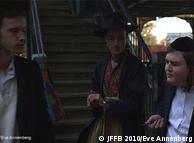
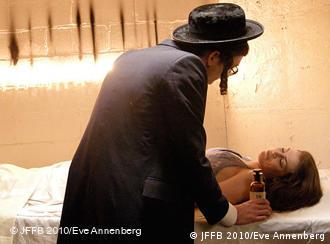
Move over Montagues and Capulets: here come the Chabads and the Satmars. The two rival sects of ultra-Orthodox Jews face off in a witty and bittersweet film titled 'Romeo and Juliet in Yiddish.'
A chance encounter between director Eve Annenberg and some members of New York's Hasidic community developed into a friendship and collaboration on the film. It explores the rough-and-tumble existence of young Jews who have left the ultra-Orthodox world behind.
Annenberg was fascinated by a younger generation speaking a language she thought was more or less consigned to the archives.
'My grandmother who spoke Yiddish and my mother who spoke Yiddish are now both dead, and I won't hear it again. And yet, the lure of speaking Yiddish and being around people with this verbal vitality is so strong,' Annenberg said.
An introduction to The Bard
The director also has a role in the film. She plays an emergency room nurse who's trying to finish her master's degree in Germanic languages. After she accepts her advisor's suggestion to translate 'Romeo and Juliet' into Yiddish, she recruits some young native speakers to help her out.
'I think this is the first 'Romeo and Juliet' where they wake up in the morning, and Romeo reaches for his glasses. That was an important detail to me. I wanted it to be, well, Jewish. And yes, we read a lot!' Annenberg said with a laugh.
But Shakespeare hasn't been on the reading list for many in the ultra-Orthodox community, which has remained closed to much of the outside world. The young translators in the film have never heard of The Bard. They also don't have much sense of romantic love.
Life meets art
In the film, Annenberg's character makes her preference for the secular clear and even declares that she hates the Orthodox.
'I'm expressing that Jew-on-Jew hostility that I'd certainly like to see less of, and I see the movie as a rapprochement between the two camps,' Annenberg said. 'If ever a bunch of people didn't understand each other that well, it's the ultra-secular and the ultra-Orthodox.'
In the film, the young translators' personal stories begin to overlap with the plot of 'Romeo and Juliet,' once they wrap their heads around it.
The back story is that these first-time actors, like their characters, are forging new lives outside of the ultra-Orthodox community where they grew up. Melissa Weisz plays Juliet and traveled to Berlin for the Jewish Film Festival where the movie premiered this summer.
'We came to Berlin and spoke to non-Jews, and it gives you a whole different perception of the world,' Weisz said. 'We were told that every Gentile would hurt us. The way we were raised is very insular and a little bit brainwashed.'
More premieres ahead
The actors' experience in the German capital was fruitful. Not only were they on hand to receive the audience favorite award at Berlin's Jewish Film Festival, they also received invitations to come back and guest lecture at Yiddish courses.
Lazer Weisz plays the Romeo character and enjoyed the feedback on the film from people in the audience.
'They like the whole idea that Yiddish is coming back to Germany. It's very nice. It makes the whole thing worth it in a way,' he said.
The film's next stop is London on November 16, and it will debut in New York in January. The screenings offer a departure from the usual Shakespearean experience. Since 65 percent of the movie is in Yiddish, the scenes from Romeo and Juliet appear with The Bard's original lines subtitled in English.
If the film continues to charm audiences as it did in Germany, perhaps another Yiddish language production will follow. 'Much Ado about Bupkes,' anyone?" (source)
Antithesis was born in South London. Music was in the family, his father had been a songwriter in his youth and his mother a keen dancer. At a young age, he took an interest in the new music phenomenon that was penetrating the pop charts – rap.
By the time he was 15 Antithesis had started writing short raps of his own. His friend gave him the name Antithesis as he is the opposite of a stereotypical rapper.
At 18 he decided to enter a song contest; the song performed had to be original lyrics and music, and had to be on a theme related to Judaism or Israel. Antithesis spent many hours with his producer ‘Tha Baron’ and came up with ‘Just Peace‘. Positive feedback from the judges and audience at what was his first live performance gave him the motivation to continue.
After school Antithesis took a gap year in Israel, taking part in the Machon L’Madrichei Chul programme. Just before going, he had heard Chaim Avraham, father of one of Israel’s Missing in Action soldiers, speak in London, and had been very moved. In Israel he heard him speak again and resolved to write a song about the soldiers’ situation in an attempt to raise the profile of the cause. The excuse to write it came when there was a talent show at the Machon and Antithesis wrote and performed ‘Ima Mechaka Babayit‘.
When Mr Avraham heard about the song, he instructed Antithesis to record it so it could be released and sold for charity, and as a result Antithesis paid his first visit to the studio. The song was a hit and saw radio play in Israel and England, in addition to exposure in the British and Israeli press. It was distributed independently on a small scale in England and sold very well.
Back in England, Antithesis took up his place to read Oriental Studies at the University of Cambridge. He continued writing, and in his first term wrote ‘Take a Minute‘, amongst other tracks. He tried to get funding to go back to the studio but found it difficult to secure support due to the unusual nature of the project. As a result in June of 2003 he decided to take things into his own hands, using all his personal savings to record the ‘The Israel Question’ EP, which went on sale at the end of the year with all profits going to charity.
Antithesis continued to write while at university but time for music was limited because of the demands of his course and other commitments; he was president of the Jewish Society and later the Israel Society, was heavily involved in the Federation of Zionist Youth (FZY) and founded the UK’s first Israeli music radio programme, Kol Cambridge, which was nominated for a BBC Student Radio Award. Of all the songs written during his time at university only ‘Ivrit, Daber Ivrit‘ was recorded (in late 2004). However during this time Antithesis gigged all over the UK, as well as in Israel, Argentina and the US, and was featured on the radio in Germany, Canada and France in addition to the aforementioned countries.
On graduating top of his year at Cambridge, Antithesis assumed the position of Mazkir (Executive Director) of the Federation of Zionist Youth, a full-time elected position. Just before starting the role the Second Lebanon War began and in response he recorded ‘Ima Mechaka BaBayit Part II‘ and ‘Yes to Peace, No to Terror‘. However it was not until finishing his term as Mazkir that Antithesis managed to return to the studio to complete his second EP, ‘United Kingdom of Racism’, which was released at the end of 2007.
After living for two and a half years in Geneva, Switzerland, Antithesis made aliyah in mid-2010 and currently lives in Tel Aviv. To date he has sold several thousand copies of his CDs and raised several thousand pounds for charity and continues to perform all over the world. He continues to write new material and new releases will soon be forthcoming!
Check out the interview he had in Israel after the lyrics below.
Lyrics
Yo, it’s time to set the record straight
Fed up with all the man proclaimin all this hate
No room for debate, well hold up wait
Cos Antithesis comin to step up and state
Yo the movement of my people been getting this stick
Equated with racism and other bullish
And if you can’t see it – that’s just foolish
So shut up and listen, to my hip hop schooling
We talking freedom, emancipation
A home, a land for a persecuted nation
Liberation, democratisation
A dream fulfilled, a Jewish safe haven
2000 years this desire had lied
Dormant but restive – it never died
In the 1800s, it was brought to life with this
Movement of my people, proud to be Zionists
Hook
I’m a Zionist – and yes I’m proud
I’m a Zionist – so shout it loud
I’m a Zionist – that’s my vocation
I’m a Zionist – self-determination for the Jewish nation
I’m a Zionist – and I’ll never cease
I’m a Zionist – who just wants peace
I’m a Zionist – and I say it with poise
I’m a Zionist – if you are too, then make some noise!
Antithesis gotta give my props, respect
To the man who got this all going and rocked the set
To be honest though, there’s no way this verse’ll
Come close to doing justice to Theodore Herzl
Ben-Yehuda, course rocked the language tip
And I already showed him love on Ivrit Daber Ivrit
Ahad Ha’am represented for the people
A cultural centre was his ideal
A man of steel was my boy Jabotinsky
I wish I had time to stand and list the
Endless achievements of AD Gordon
Love the land was his plan, and it was awesome
The Lord was put forward by the man Rav Kook
His intellect and stature never done shook
That’s the look, so take pride in it
Pay respect with me, cos I’m proud to be a Zionist
Hook
I’m a Zionist, so give me my word back
There’s too many man, trying to turn that
Into something negative, something bad
I’m a Zionist who ain’t ashamed, I’m glad
That I support universal suffrage, free press
Only place in the Middle East to pass that test
Nothing less, cos we strivin for perfection
It’s a work in progress, like all other Western
Nations, but to be Zionist don’t equal extreme
Don’t make you obscene, unkind or unclean
What it means, is that you believe that the Jewish state
Has a right to exist, secure and safe
People livin without fear, living in peace
That’s the essence of a Zionist belief
No more beef, I’m done defining it
Join with me and shout that we proud to be Zionists
"Trailer below: During a panel discussion about Shlomi Eldar’s award-winning documentary 'Precious Life,' the closing night film of the 25th Annual Israel Film Festival in Los Angeles, audience members were treated to a pleasant surprise: the subjects of the film video-conferenced in from Gaza to participate in the talk.
'Precious Life' documents the triangle between Israeli television correspondent Shlomi Eldar, pediatric surgeon Dr. Raz Somech and Palestinian mother Ra’ida Abu Mustaffa. Against the backdrop of Israel’s 2008-2009 blockade of Gaza, Dr. Somech calls upon Eldar to help him raise awareness for Ra’ida’s baby, Muhammad, who was born with an immune deficiency and needed a $55,000 bone marrow transplant procedure to survive past infancy. After an anonymous donor provides the funds, Eldar and Ra’ida engaged in a series of intense discussions that highlight the many complex political and religious issues facing the modern Middle East.
Both Ra’ida, her husband Faozi and his son Muhammad, who is now three, used video-conferencing technology to participate in a discussion with Eldar, film producer Ehud Bleiberg and moderator Sharon Waxman to talk about their reactions to the film. Ra’ida, who is fluent in English, began by noting that her son’s health was 'not good,' before saying that the documentary, for obvious reason, hasn’t played in Gaza and only her immediate family has seen the film. She added that she was actually afraid for her neighbors to see the film, because they wouldn’t necessarily understand why she took the actions that she did. Dressed in a green head scarf, she ended the talk on a more optimistic note, noting that given her experiences, she had hope for the future.
After Ra’ida and her family signed off (the event was taking place at 7 a.m., Gaza-time), Eldar echoed Ra’ida’s thoughts and said that he was optimistic that Israel and Palestine will eventually find peace. He added that he hopes the 'cognitive dissonance' that that he initially encountered when shooting the film will apply to others who watch the film as well, and help them see individuals who they’d normally consider an enemy, are actually human beings as well.
'Precious Life' will debut on HBO in the second quarter of 2011." (source)
"Israel and Britain signed a cooperation agreement in the field of cinema on Wednesday after 10 years of intense negotiations. According to the agreement, Israel will become a favorite filming location for British films while production companies will get financial incentives and tax benefits from Israel to shoot in the country.
The deal was signed by Foreign Minister Avigdor Lieberman and his British counterpart William Hague, who is currently visiting Israel, reports YNetNews.
Israel's Foreign Ministry estimated that British films may start being filmed in Israel very soon. One option that is being considered is shooting parts of the next James Bond movie in Israel.
The deal was signed after a decade of diplomatic efforts at a time when many UK cultural and academic establishments are calling to boycott the Jewish state. The agreement's financial and economic potential is huge: The British film industry makes over £5 billion ($8 billion) a year and is ranked third in the scope of production after the United States and India.
The deal will provide Israeli cinema with massive exposure and will increase the film budgets Israel recieves from overseas sources.
Meanwhile, UK filmmakers are already at work to produce two films about the British mandate period which may be filmed in Israel. A British delegation is slated to visit Israel in the coming months to consider future collaborations.
Israel's Ambassador to Britain Ron Prosor, who played a major role in brokering the deal, said: 'Signing the agreement was one of the important goals I set for myself.'" (source)
"Movie by first-time Israeli filmmaker Samuel Maoz based on personal experience as part of tank crew in First Lebanon War.
The European Academy of Film announced on Saturday that the Israeli movie 'Lebanon' has been nominated for five European Film Awards.
Lebanon will compete in the Best Movie, Best Director, Best Screenplay, Best Cinematography and Best Editing categories in the European equivalent of Hollywood's Oscars."
Another Israeli movie that was nominated in 2007 was 'Beaufort'
"A lone Israeli among China's thousands of kung fu adherents, Shmuel Shoshtari was thrilled to be his country's flag bearer at the martial art's main event.
Shmuel Shoshtari proudly carried the Israeli flag at an international kung fu competition in China in October. He enjoyed the privilege - so he says - not because he is a master of the martial art, but because he was the only Israeli the organizers could locate among China's thousands of kung fu students.
'I am not good enough to compete against these people,' 22-year-old Shoshtari tells ISRAEL21c in an interview via Skype from the Shaolin Wushu School of Kung Fu in Deng Feng where he has been studying since January 1. 'They have been training for years while I have been training for a few months. It would be like asking you to compete against Michael Phelps because you know how to swim - or because you have a bathing suit.'
But since Israel hadn't sent a delegation and the competition planners wanted representation from as many countries as possible, they made inquiries at the 60 kung fu schools in Deng Feng, seeking an Israeli, and they found Shoshtari.
He describes the event, held in Zhengzhou, as 'the kung fu equivalent of the World Cup or Olympics,' taking place every four years. Martial artists arrived from across the globe, including Japan, Tanzania, India, Spain, Macau, China, Singapore and Argentina. Even the prince of Trinidad and Tobago came to take part in a sparring contest.
In training since age five
'Both the school and I knew I wasn't good enough to compete,' Shoshtari insists. 'There were people there from the Chinese National Team and others who've been training since childhood. A week before I went, I trained with a competition group at my school, which includes the best of the 5,000 students here, ranging from eight to 17 years old. You see these 10-year-olds with unbelievable power.'
For a person who has been training for only a few months, he acquitted himself quite well. 'In open fist form, I got ninth place out of 12, and in spear form I placed 10th out of 16. You can make very small mistakes; your leg can slip a bit on the carpet and they take away points.'
Shoshtari was born to an American mother and an Israeli father living in a small agricultural village, Moshav Haniel, in central Israel. When he was about five years old, his parents sent him to learn krav maga, the Israeli self-defense system. Years later, he took an interest in kung fu, one of the oldest martial arts forms in the world.
'Kung fu has so much precision and power in the moves - that's what it's about. It's like classical music,' he explains.
Shoshtari eventually met an older student who'd studied in China, and found the notion of spending a year at such a school irresistible. He learned some Chinese, saved some money, quit his job in software development, and went at the end of December. 'My father thought I was out of my mind,' he recounts.
Perception of Jews, Israelis is phenomenal
Living in a dorm under fairly stark conditions with two 12-year-old Korean roommates, Shoshtari wakes at sunrise for intense power training - sprinting, running upstairs, jumping - to increase stamina and muscle development. After breakfast and a break, there is another long session on techniques and forms, then more training following a break and lunch. Twice a week, night sessions are added. 'I couldn't run before I came here,' he confides. 'I was totally out of shape. This place really changed my body and was a great experience.'
Fortunately for Shoshtari, who tries to observe the Sabbath, the schedule is more easygoing on Saturdays. He spent the Jewish holidays in Shanghai, where there is an organized Jewish community.
'As a Jew, it's amazing to be in a place where the perception of Jews and Israelis is phenomenal,' he says. 'They all want to take pictures with me. They consider us very clever, and they respect us. I've met people here from all over the world who never met religious Jews and they're all very nice.'
At the opening ceremony of the Wushu competition, national flag-bearers stood in alphabetical order. That put Shoshtari next to the athlete from Iran. Though Israel and Iran are not on good diplomatic terms, Shoshtari has found that such tension is irrelevant on an individual level, and he gets along just fine with an Iranian student at Shaolin Wushu.
Shoshtari plans to return to Israel at the end of the year and pursue studies in electronic engineering. He expects to return to krav maga roots as well, while keeping up with kung fu informally. 'I think I'll be reviewing what I learned here for years,' he states. 'Like playing a classical piece, you can always improve your speed, power, and precision.'" (source)
Celebrating Arts & Craft in Jerusalem - For two weeks every August, Sultan's Pool, the valley beneath the walls of Jerusalem's Old City, thrums with the full spectrum of culture.
An annual event for 35 years, Jerusalem's International Arts and Crafts Festival, taking place in Sultan's Pool below the Old City walls, is the largest cultural event in the country, showcasing arts, crafts, music, theater and food - from Israel and all over the world.
The International Pavilion boasts arts and crafts from more than 30 countries and a small stage for performances from attending countries.
In the Israel section, the wares of more than 150 artists and craftspeople are offered for sale. Secrets of various trades are revealed, like those on display at the annual glass blowing demonstration. There are workshops for children as well. This year's highlight was a workshop all about bees, with a glass-encased beehive transported to the festival as an irresistible draw.
Small stages and wandering performers abound throughout the festival grounds, and there's a main stage where top Israeli performers appear over the two weeks, such as Noa, David Broza, Aviv Gefen and internationally renowned hip hop band Hadag Nahash (SnakeFish).
It's easy to see why Jerusalemites who first visited the festival as children return year after year, until they're coming with children of their own.
Transforming it into giant silver mammoths, pseudo aliens and sinuous snake-like creatures, an Israeli dance troupe re-defines aluminum.
Recently returned from a four-month US tour and slated to fly back soon, this time for a six-month stay, the Israeli dance extravaganza dubbed Aluminum, founded by Israeli dancer and choreographer Ilan Azriel, will completely change the way you think about this versatile metal.
The idea was born when Azriel opened a box in a hardware store one day and a piece of aluminum fell out. He started to play around with the snake-like object, fascinated by the way it moved. He began to imagine the play of lights on the silver substance, as dancers wore it on their bodies.
Born in a hardware store aisle, today, Aluminum is a full-length performance of visual theater for six dancers that has toured the world, with stops in Africa, Asia, and North and South America.
His latest book has won this year's Man Booker prize, the most prestigious award in English literature, but fans of Howard Jacobson might be alarmed to discover that the main character in The Finkler Question is a gentile.
As it turns out, though, they needn't worry. Julian Treslove may not be Jewish, but in most other respects he's a typical Jacobson protagonist: a middle-aged man much given to tears, self-interrogation, a sense of imminent doom, falling heavily in love and regarding his male friends as his rivals. Above all, he's obsessed with Jews and Jewishness.
When The Finkler Question begins, Julian, a failed BBC producer, has just had dinner with two of his oldest friends/rivals. His old schoolmate, Sam Finkler, is now an irritatingly successful popularizer of philosophy and so Jewish that Julian privately thinks of Jews as 'Finklers' (hence, among other things, the book's title). Their former teacher, Libor Sevcik, is solidly kosher too -- and locked in an endless argument with Finkler about the State of Israel: Libor's for it, Finkler isn't.
Then, on the way home, Julian is mugged by someone who, he later becomes convinced, used the words 'you Jew' during the attack. What if the attacker knows more than he does? What if he is -- as he's perhaps always wanted to be -- Jewish too? Before long, he's certainly giving it his best shot, brushing up on his Yiddish, wondering if it's too late to get circumcised and moving in with a woman called Hephzibah Weizenbaum.
Not that he finds it easy to blend in with his 'fellow' Finklers. For one thing, there's their puzzling custom of telling jokes about themselves that they'd angrily resent from anyone else. (Luckily, this custom allows many of Jacobson's own gags to be fearlessly tasteless.) For another, even he can't really match their obsessiveness. After all, 'you have to be born and brought up a Jew to see the hand of Jews in everything. That or be born and brought up a Nazi.'
Meanwhile, Finkler is on a very different trajectory. Appearing on BBC's iconic Desert Island Discs (much, naturally, to Julian's envious horror), he declares that
Israel's treatment of the Palestinians makes him 'profoundly ashamed.' As a result, he's invited to join a group called 'Ashamed Jews,' who meet regularly to debate, often rancorously, just how outraged they are by the Zionists.
As this might suggest, The Finkler Question is quite a schematic novel, with the characters there primarily to embody the ideas that Jacobson wants to discuss. In a book never short of competing theories, plenty are put forward as to why Julian is so keen to be Jewish, but the main reason is surely just Jacobson's desire to set up a bitterly comic contrast between him and all the real Jews who seem so keen not to be.
There's also a full supporting cast representing every possible shade of Jewish opinion -- and, while Jacobson tries to follow the approved fictional practice of presenting the conflicting viewpoints and leaving the reader to judge, it's increasingly obvious which side he's on. The Ashamed Jews get a merciless (but extremely funny) kicking throughout.
And just in case that's not clear enough, the final sections deliver a series of fairly transparent author's messages warning about the uncomfortably close links between anti-Zionism and anti-Semitism, and savaging the glib parallels drawn by Israel's critics between the Holocaust and the events in Gaza.
By the end, in fact, the urgency of these messages is so unavoidable as to create the sense of a book that changed its own idea of what it should be as it went along -- as if Jacobson had gradually decided that, in such perilous Jewish times, some things are more important than turning in a well-ordered novel.
All this might have been more damaging if he wasn't so good at the disordered kind. The spectacle of him letting rip remains as exhilarating as ever -- and in any case, nobody will ever read his work for its decorous understatement. Jacobson has often said that one of his key writing mottoes is 'More is more' and here again he sticks firmly to that principle (only more so).
For some writers a thorough investigation of the situation of Jews today might do as the subject for a single book. In The Finkler Question it's combined with his characteristically unsparing -- but not unkindly -- ruminations on love, aging, death and grief. He also manages his customary -- but not easy -- trick of fusing all of the above with genuine comedy.
And sentence by sentence, there are few writers who exhibit the same unawed respect for language or such a relentless commitment to re-examining even the most seemingly unobjectionable of received wisdoms.
No wonder that, as with most of Jacobson's novels, you finish The Finkler Question feeling both faintly exhausted and richly entertained.
As the chair of this year's Booker judges said, it is 'a completely worthy winner of this great prize. The Finkler Question is a marvellous book: very funny, of course, but also very clever, very sad and very subtle.'
It is the 68-year-old author's 11th novel, though his first novel, Coming From Behind, only appeared when he was 40. He has been longlisted twice before for the Booker, in 2006 for Kalooki Nights and in 2002 for Who's Sorry Now.
Britain's press praised the Booker choice, with the Guardian newspaper hailing 'a victory for that most overlooked genre on literary prize lists, the comic novel.'
The Independent said awarding the prize to Jacobson 'broke the mould. It was predicted to be the most likely loser, not least because a comic novel has never satisfied the tastes of high-minded judges.'
Jacobson has often been compared with the American writer Philip Roth, who has also written on the themes of Jewishness and relationship. Jacobson himself however, begs to differ: 'I'm not the English Philip Roth, I'm a Jewish Jane Austen,' he told the Guardian newspaper in a recent interview.
He deplores the false categories of 'literature' and 'entertainment' as if they are mutually exclusive.
'I mean, I am a pleasure giver. I am an entertainer. I give fun. I make people laugh. I am not difficult, though there might be the occasional Yiddish word people don't know. It has always bewildered me that people don't want to read me in large numbers.'
Tongue-in-cheek? The point about Jacobson is that he's at his most serious when he's joking." (source)
"The 25th Anniversary Gala for the Israel Film Festival in Los Angeles attracted a number of Hollywood stars to the Beverly Hilton Hotel. Among the honourees this year are Richard Dreyfuss (actor and founder of the Dreyfuss Initiative), Avi Lerner (Co-Chairman & CEO of Nu Image/Millennium Films, The Expendables) and Jon Landau (COO of Lightstorm Entertainment, producer of Avatar, The Titanic).
Dreyfuss received the festival’s Career Achievement Award; actor Topher Grace presented Ryan Kavanaugh with the Outstanding Achievement in Film Award; and Sylvester Stallone was on hand to present Lerner (who recently produced The Expendables, starring Stallone) with the Lifetime Achievement Award.
'It was an incredible evening with each of the honourees speaking so passionately about Israel and praising the success of the Israeli film industry around the world,' founder and executive director of the festival Meir Fenigstein said in a statement.
Comedian Elon Gold acted as the Master of Ceremonies for the gala, which featured many Israeli directors, including Avi Nesher. Nesher’s film The Matchmaker (which premiered at TIFF) opened the festival.
This year’s featival -- which runs until Nov. 4 in Los Angeles -- will feature two closing night films: The Human Resources Manager, Israel’s Oscar entry, and Precious Life, a documentary that had its premiere at TIFF.
Turn Left at the End of the World, I’m Not Jerusalem, Rage and Glory, Out of the Box, Neighbors and Murders, Lone Samaritan, A Duck’s Journey, Theives by Law, Amos Oz: The Nature of Dreams, I’m Not Filipina, Blood Relation, A History of Israeli Cinema, A Matter of Size and There Were Nights will also be screened at the festival.
"Bulgaria's second largest city of Plovdiv became Friday the host of an exhibit of works of Israel's top artists.
The exhibit, including masterpieces of over 10 Israeli authors, is on display at the office of the Bulgarian Member of the European Parliament from the ruling Citizens for European Development of Bulgaria (GERB) party, Emil Stoyanov, and promises to become on of the key Bulgaria-Israel art events of the year.
The works include oil paintings, graphics, photographs and video installations, Stoyanov press center informs.
The display was officially opened by the Ambassador of the State of Israel to Bulgaria, Noah Gal Gendler, and Deputy Foreign Minister, Dimitar Tsachev, in the presence of the Israeli Member of the Parliament, Lia Shemtov, the Mayor of Haifa, Israel Savion, and members of the Bulgarian Jewish community.
The event was covered by the largest circulating daily in Israel – Haaretz.
Stoyanov is the organizer of the exhibit under his capacity of member if the EP Delegation for Israeli Relations." (source)
"One person can make a difference in the lives of thousands.
That is the message of 'Wallenberg,' a musical that opens Saturday night at the White Plains Performing Arts Center in White Plains, N.Y.
The production brings to life the story of Raoul Wallenberg, who at the age of 32 left his wealthy family and the safety of Sweden to save Jews in Nazi-occupied Hungary in 1944. Using every means at his disposal, the Swedish diplomat succeeded in rescuing more than 100,000 Jews within a six-month period.
In January 1945, the Soviets, who had just entered Budapest, abducted and imprisoned Wallenberg, perhaps because his mission had been funded entirely by the United States. He was never again seen in the free world. Though the Soviet government announced that he had died of a heart attack in prison in 1947, many former Soviet prisoners who came out of the gulag in the decades since then reported that they had seen, spent time with, even befriended Wallenberg in various prisons and institutions. The last such report was in 1981. That same year, President Ronald Reagan made Wallenberg an honorary U.S. citizen.
While Oskar Schindler is a household name, largely because of the film 'Schindler’s List,' Wallenberg — who saved many more people — is virtually unknown, the show’s organizers lament.
'He saved more people than any other person or organization and he risked his life to do so,' said Benjamin Rosenbluth, the Teaneck composer who wrote the score for the production. 'This story screams to be told passionately to the public, and what better way than through a musical?'
But 'Wallenberg' should not be mistaken for a 'Holocaust musical,' Rosenbluth insists. 'It’s the story of an incredible optimist. It conveys a very positive message about what an individual can do to impact the world.'
Rosenbluth, who was classically trained in piano and composition at Juilliard before going on to earn an M.D. degree at Harvard, has been writing music since he was a child. He has worked with such big names as Marvin Hamlisch; his compositions have been performed by symphony orchestras; and a ballet was performed at Lincoln Center. The opportunity to write music for this dramatic story was 'too exciting not to tackle,' said Rosenbluth, the 37-year-old father of four.
He began working on the project in 2004 with writers Laurence Holzman and Felicia Needleman, collaborators who have won awards for their musical comedies and librettos.
Holzman had come up with the idea of a Wallenberg production years ago, while teaching a sixth-grade Hebrew school class about the Holocaust. He noticed a footnote about Wallenberg in the class textbook and was stunned. 'I had a solid Jewish education and never learned anything about him,' he said. 'If he saved more Jews than any other organization or government, why don’t people know about him?' He called Needleman, his longtime writing partner, and told her, 'We have to tell this story. I don’t want my kids’ idol to be Britney Spears when there are incredible people to look up to.'
Through their shared background at the BMI Musical Theatre Workshop in Manhattan, the writers discovered Rosenbluth, whom they credit with creating an exhilarating score.
'Benjy’s music is so lush and beautiful,' said Holzman. 'His melodies are so sweet. He really captured the epic nature of the story with the music.'
That the project has taken so many years to bring to fruition is in large part because the writers aimed to tell the story without bending historical facts. They spent months researching Wallenberg’s life. They even held readings for survivors who were saved by Wallenberg to ensure authenticity.
A group of 'Wallenberg Jews' attended a 2004 reading at Manhattan’s Symphony Space and admitted that they had initially been nervous the play wouldn’t be respectful to their history. But the play moved them. 'An elderly woman stood up after the reading and exclaimed, ‘That was me you just portrayed when he pulled me off the death march.’' Someone else said that she saw herself in a scene that depicted Wallenberg creating fake passports for Jews. Wallenberg’s niece came in from France for a reading and then met with the cast to give them a better sense of who the characters were because she knew them. 'We heard the stories directly from the people who experienced it,' said Rosenbluth. 'That was mind-blowing.'
Their input had a considerable impact. 'We changed large portion of the script based on what they told us,' said Rosenbluth. And every Wallenberg Jew who saw the final show in rehearsals said they were grateful their story was being told with respect, accuracy, and heartfelt emotion, he said.
The show’s producers hope to bring it Broadway. But in the meantime, they are reaching out to schools across the tri-state area to arrange for students to see the show, which has been funded in part through the International Raoul Wallenberg Foundation, a non-profit organization that aims to publicize and promote the good works of Wallenberg and other heroes of the Holocaust.
Like other members of the creative team behind Wallenberg, Rosenbluth has family members who were killed in the Holocaust. But he doesn’t have any qualms that the production would trivialize the memory of the six million. Yet when the director initially asked him to write music for a character portraying Adolf Eichmann, he balked. 'I said, 'How can evil sing?' He looked to opera as a model, since evil is widely portrayed in opera in a powerful manner.
How does he work by day at Holy Name Medical Center as a radiation oncologist and manage to write the score for a large-scale production? 'I don’t sleep much,' he quips, adding that much of his composing takes place after around 9 p.m. 'I’ve written songs between seeing patients. My nurse can probably hum all the songs to the show because I walk around the hospital singing.'
Rosenbluth, who is Orthodox, said he hasn’t encountered much conflict in being a composer and keeping the Shabbat. 'My go-to person is Dudu Fisher. They wanted him to sing for the queen of England and he said he would do it but never on a Friday night. I’ve worked with non-Jews and non-religious and anti-religious Jews. I feel if people see you are very serious about your religion, they respect it. But that means you have to be shomer kashruth on every level — not only watching what you eat but watching how you act, what words come out of your mouth. Even the most hardened anti-religious person respects someone who stands by his principles.'
On Tuesday, Nov. 9, a special performance will be given at 8 p.m. in observance of Kristallnacht, the anti-Jewish Nazi attack on Nov. 9-10, 1938, which many scholars consider the beginning of the Holocaust. The show will run until Nov. 21.
For more information about the show and to hear some of the music, go to wallenbergthemusical.com.
"It's the only Japanese museum in the Middle East, and the turbulent history of the collection is as inspiring as the museum itself.
An unlikely and little-known treasure trove in Israel's north is the Tikotin Museum of Japanese Art. It houses thousands of pieces and is the only museum of its kind in the Middle East. Located on Mount Carmel in Haifa, it has recently attracted the attention of NHK World, a Japanese TV channel which plans to film a program dedicated to the collection.
The museum is currently celebrating its jubilee year, an occasion it is marking with a special 'Highlights' exhibit. Spotlighting remarkable pieces from the spectrum of Japanese history, according to chief curator Dr. Ilana Singer, it contains 'a little bit of everything' - ceramics, swords, paintings and prints.
A second exhibit displays new acquisitions, while a third offers a glimpse into the life of museum founder Felix Tikotin, a German-Jew who collected, lost and then refound, most of the treasures in the museum.
Tikotin, an architect, began building a collection of Japanese art before World War I. Afterwards he became an art dealer in Germany, specializing in Japanese art and continuing to build his own collection.
When the Nazis came to power in Germany, Tikotin went into hiding, and his collection was lost. In 1950, however, Dutch police called Tikotin in as an expert after they discovered art thieves trying to smuggle a collection of Japanese art out of the country. Tikotin discovered the collection was his own. Four years later, he decided to give the pieces to Israel.
A fascination with all things Japanese
Aside from housing Tikotin's collection, the museum also serves as a cultural center, catering to an increasing Israeli fascination with Japan. A two-week summer program for children introduces elements of Japanese art and culture, but the majority of the programming caters to adults. In addition to academic lectures and screenings of Japanese films, they can choose from classes in Japanese language, writing, ink drawing, origami, and even flower arranging.
'I think the museum serves as a place where people have a chance to meet this culture through its art,' Singer tells ISRAEL21c.
Singer, who creates her own prints, has a passion for all things Japanese. 'My fascination with Japanese art started with a fascination with Japanese people,' she explains.
When she was a child, a Japanese family lived on her kibbutz, Heftziba, and she would visit them from time to time. Many Japanese young people also came to the kibbutz to study Hebrew.
'Later on when I was a teenager, I had an amazing art teacher who introduced me to Japanese woodblock prints. So I have had this 'virus' ever since, and it does not go away,' says Singer.
'I am attracted to the esthetic and philosophy of Japanese art, and I relate strongly to the art of the different periods. For example, I can relate to the Zen painting of one period, while responding just as strongly to the netsuke - small figurines - of the later Edo period. Each period of Japanese art has something different, something special, but in all Japanese art, the artist is aiming for perfectionism.'
The art of perfection
That, Singer tells ISRAEL21c, is what makes Japanese art unique. 'I think it's their ability to make anything, big or small, absolutely perfect.'
In its 50th year, the Tikotin is still the only museum in the Middle East dedicated to Japanese art and culture. Its collection of over 7,000 items ranges from drawings, paintings, woodblock prints, ancient illustrated books, ceramics, miniature netsuke sculptures, metal and lacquer works, antique Samurai swords and knives, to household objects such as fans and tea sets.
While the collection spans the seventeenth to nineteenth centuries and includes contemporary Japanese art, there is a particular concentration of art from the Edo period (1600-1868).
Singer explains that those centuries signified a revolutionary period in Japanese society, and consequently for its art. The middle class gained ascendancy through newfound wealth, she explains, and new artistic forms such as Kabuki theater began to flourish.
'The subjects of Kabuki were better suited for the lower classes - it was more colorful, with a lot of activity,' Singer says. Then the popularity of Kabuki spilled into the visual arts of Japan. 'Woodblock prints depicted Kabuki actors, who were the celebrities of the time,' she explains.
Reaching a Japanese TV audience
Distinguishing between historic and contemporary Japanese art, Singer says, 'Traditional Japanese art uses specific subjects that were familiar at the time, like Kabuki actors, scenes of Japan, or beautiful ladies who wandered the streets of Tokyo, or Edo.
'In contrast, in contemporary art there isn't a common subject - like artists all over the world, they look for their own impressions.' Yet through all the centuries and still today, says Singer, 'One thing about Japanese artists has remained the same: Their ability to create something which is perfect and complete and very clean. Their techniques and composition have a sense of purity - a sense you can find both in traditional art and in contemporary art. When you see it, you know it's Japanese.'
Though unique and alone in the Middle East, the Tikotin is in contact with museums in Japan, and receives support from the Japanese embassy in Israel and the Japan Foundation.
Now the museum has been chosen to feature in a special program for Japanese TV. 'We are really looking forward to this,' enthuses Singer. 'People from NHK visited us with specialists from Japan who were very impressed with the collection of treasures here. They really want to make the program, and we will most likely do it next year.'" (source)
"Fashion and the natural world don’t always go hand in hand (unless you’re lucky enough to come across some whimsical banana-shaped pumps by designers such as Kobi Levi). Usually haute couture is the anti-natural, with silhouettes that combat the shapes that we were born with and materials (such as fur) that require the destruction of something natural. Yet in an attempt to come up with a national garment for Israelis, fashion designers decided to center their inspiration on the natural. Namely, on Israel’s only fresh water lake, the Sea of Galilee.
Displayed in a garment design contest/fashion show in Tiberias (a city that is located on the shores of the Sea of Galilee) during the last few days of Sukkot, the designers demonstrated that the natural is a powerful source of inspiration.
The designers were also calling attention to the fact that the lake is in serious trouble in need of a serious makeover.
The Sea of Galilee is Israel’s largest fresh water reservoir and is a major source for Israeli water consumption. The water levels have steadily declined over recent years, due to years of drought, and now the levels are so low that there is danger that the lake may become salt water.
Liraz Rubin, one of the fashion designers whose work was displayed in the show, said that 'my design is inspired by the lake, where the fish want to live but the water is getting scarce and the lake is sad. You can see in the design itself that the fishermen can hardly find any fish. It’s a cry to save the Sea of Galilee and its fish.'
For some of the judges, though, the focus was more on fashion and less on conservation. Yuval Kaspin, an Israeli celebrity designer and one of the judges, said that 'in some of the designs the connection between the Sea and the garment was definitely discernible. The designs which caught our attention the most were those that indeed reminded us of the Sea, but did not ‘over-chew’ the concept for us.'" (source)
"Trend that began with billionaires Arcadi Gaydamak and Roman Abramovich gaining popularity, as more and more Israelis willing to fork out a lot of cash to have artists such as Boney M, Gypsy Kings perform for their guests. 'People here love to impress, and having Kobi Peretz ay your wedding doesn't impress anyone anymore,' local promoter says.
A resident of an affluent central Israel neighborhood wanted Shakira to perform at his wedding; so much so that he was willing to fork out hundreds of thousands of shekels to bring the Colombian singer to the country. Eventually he had to make do with the finalists from the 'Star is Born' TV show (Israeli version of 'American Idol'), who didn't come cheap either.
Until recently, local artists such as Sarit Hadad and Eyal Golan ruled the private party circuit, but the past few months have seen this trend change, with more and more international artists being booked to play at private Israeli events. Three such events are set to take place in October, including a performance by the Gypsy Kings at an annual bash thrown by hotel magnate David Fattal in Eilat. In case you were wondering, the band will rake in close to $50,000 for the gig."
"Jewish history features enough real apocalypses to daunt even the most powerful imagination. But that didn't stop Joshua Cohen from producing Witz, a colossal novel about the last Jew on Earth.
Benjamin Israelien, a Candide-like innocent, is the sole survivor of the extermination-by-plague of all the other Jews in the world at the turn of the current millennium. But Ben is not a very Jewy last Jew. His hair is blond, his eyes are blue, and his foreskin regenerates after every attempt to circumcise him. (I imagine Jesse Eisenberg playing him in the movie.) His level of religious observance is also minimal, which becomes a problem when the world begins converting to Judaism.
Cohen's most fundamental inversion in Witz is to ditch the familiar tropes of anti-semitism and make the book's alternate present an intensely philo-semitic one, with the destruction of the actual Jews sparking a perverse Jewish revival. Not just of the religion, either: people get their noses enlarged, trade their Anglo names for Jewish ones, etc. With more and more goyim converting, Ben quickly becomes a celebrity (the last of something!), then a pariah (not Jewish enough!), and finally a fugitive in a newly and entirely Jewish world.
I give only the skeleton of a plot because that skeleton is more or less the only plot there is in Witz. What drives this book is not events or characters but language: the snaky kinds of sentences found in maximalist masterpieces like Ulysses and Gravity's Rainbow. If you can roll with the punches to get to what's real in Joyce and Pynchon, you ought to be able to roll with them here, but be warned that this book will not be an easy read. A representative sample of the prose:
Ich bin Doktor Froid, also sprachs the apparition meeting Ben over the threshold holding open the door by a muscular and hairy hydrostatic tentacle suckling knob; and either this is the language aliens speak, or the good Doktor's just flown down from atop Mount Sinaius, affecting the sentimental out one nostril, the nostalgic out the other – two tablets to assuage the adenoidal, with an additional heil from tonsils deep in the glottal to this indescribably guttural European language, spoken today in no Europa known; a tongue ethnically tentacular itself as it's reaching, always louder and damning, both velar and palatal but always emphatic, whatever it is, and from where besides the mouth opened wide in His very own head. Und your acquaintance, it says, or he, ist very gut to finally macht…waddles up from the armchair on four of his or its seasidereal, iridescent appendages, to greet Ben with two suctorial kisses, one for each cheek, which Ben's then compelled to return unfairly, with four kisses, one for each of the cheeks of the Doktor, or for what He perceives as cheeks, which are really four faces, each slickly bearded and with two cheeks each of their own, sopping with respiration's expectoration or shvitz.
That's the paragraph that heads the book's most science-fictional episode, which finds Ben aboard a spacecraft helmed by a Freudian-Zoidbergian alien doctor devoted to preserving the last of everything.
I ought to note that Ben isn't the only last Jew in the book. His story ends a number of pages before Witz itself does, and the remainder is a Molly Bloom-like transcript of the experience of another who merits the badge of lastness: the last living survivor of the Holocaust. 'Joseph ben you don't know him much like God I don't need a last name' is what he calls himself, and while his share of the book is brief, it's as potent as the hundreds of pages that come before it.
The dual-world mechanics employed by Cohen, as well as his encyclopedic and berserk style, strongly recall the juxtaposition of real and alternate histories in Sesshu Foster's Atomik Aztex. That book's hero was both a humble meatpacker in this world and a proud warrior in one where the Aztecs conquer Europe. While Witz claims no identity between Ben and Joseph, it shares with the other book a concern with the arbitrariness of history and of victimhood.
Ah, victimhood. Anti-semitism in America never reached the genocidal heights it did in Europe, and many of the current generation of American Jewish novelists ('The targets might be Michael Chabon, Jonathan Safran Foer, Shalom Auslander,' Cohen said in an interview in March) appear unable to affect anything beyond the sentimental or the nostalgic when wrestling with the topic in their own work. Witz is designed to end that tradition. As art it succeeds, and as alternate history it's an expert satire of both the American Jewish literary canon and the privilege currently enjoyed by many American Jews (myself included). Any future Jewish epics are going to have to start from zero.
"Put an Israeli Arab, a Jewish settler and a large man with no tact in the same room and you can see the sparks fly. Put it on television and you can call it comedy.
Israel is the latest country to see the 'The Office' -- or 'HaMisrad' -- on its TV screens. The hit British comedy originally penned by Ricky Gervais and Steve Merchant has spawned spin-off series across the world, including in the U.S. where it starred comedian Steve Carell.
The Hebrew version shares much with the British original like the awkward car-crash moments when personalities collide in an office -- but with one basic difference.
'The Israeli culture is almost opposite [to British culture],' says Uzi Weill, the screenwriter who adapted the UK version for an Israeli audience.
'Where the British would be embarrassed, the Israeli would be embarrassing. The British would be reserved, the Israeli would just say it flat to your face.'
The Israeli version deals in a healthy amount of stereotypes -- Arab, settler, Russian, Ethiopian, tired old businessman. But then it starts to challenge what you think you know about that character.
'It does change the inner way you look at things, you are not as set in the way you perceive reality,' says Weill.
Jamil Khoury plays Abed, the Israeli Arab who does everything he can to blend into the predominantly Jewish office. He says his character is different to Arab characters usually seen on Israeli television.
'Arab stereotypes are not so bright -- stupid sometimes -- but this Abed guy, he turns everything around, he knows a lot,' Khoury told CNN.
Abed is also involved in an explosive storyline for an Arab character: He is gay and seen kissing his boyfriend by an office colleagues. It is a scene Khoury hopes will help to break down homophobia within the Arab world.
Khoury said: 'People say shame on you, how can you do this? Just for acting it. It's not so common. I know there are a lot of Arab gays here but nobody knows about them; they stay closed.'
Actress Ayelet Robinson plays Leah, an Israeli religious settler who Robinson describes as 'constantly pregnant.'
'She's very religious but I think also she's very jealous of the other lifestyle, the non-religious lifestyle and I think inside of her she wants to be something else,' Robinson told CNN.
'It begins with the stereotype and then you discover other things inside her,' she said.
Robinson said she loves the fact that the show holds a mirror up to Israeli society and hopes it will help break down prejudices.
Robinson grew up in a religious family and says she had her own built-in bias to break: 'This way of looking at Arabs that I grew up with, that you have to be nice to Arabs but don't trust them, don't show your back to them, and this kind of devilish fear.'
The British version of 'The Office' starring Ricky Gervais as horribly embarrassing David Brent has been shown in dozens of countries worldwide.
The Israeli show, just halfway through its first season, is considered a success and a second season has already been commissioned. Weill will return as screenwriter: 'In the second series, I would like to insult some more stereotypes,' he said.
And the equivalent of that famous scene where David Brent shows off his dancing moves to a horrified office? His Israeli counterpart, Avi Meshulam, a rather large fellow, performs a belly dance with a silk scarf." (source)
British Film Director Mike Leigh is set to visit Israel in November.
He will arrive in the Holy Land on the 20th of November to teach for a week at Jerusalem's acclaimed Spiegel television and film school.
Leigh is coming to Israel as part of the programme of "Great Maestros" that will also see directors David Lynch and Wim Wenders teach at the school.
During his visit, in coordination with the Cinematheque in Jersualem, Cinematheque Tel Aviv and Cinematheque Haifa, Leigh will deliver workshops over three days to students and graduates of the Spiegel School, he will also receive an honorary degree on the final evening of his visit, he will also visit Palestinian students at the Jenin cinema.