So you've all heard how "terribly" Israel treats its Arab population. Here's a video about how Israel treats its Bedouin population.
Showing posts with label Bedouins. Show all posts
Showing posts with label Bedouins. Show all posts
(SOCIAL) Druze & Bedouin Join ZAKA's Rescue Operations
"Israeli rescue organization ZAKA is now training volunteers from minority communities to be first responders in the wake of tragedy.
For 15 years, Israel's unique voluntary rescue organization, ZAKA, has been sending volunteers to work alongside law enforcement and emergency personnel following acts of terrorism, accidents and natural disasters across the globe.
Now ZAKA is expanding its network within Israel to better serve Arab, Bedouin, Circassian and Druze populations. Two new units in the north and two in the south will be staffed by members of those minority communities, after receiving training that will be adapted to their own religious and ethnic customs.
Until ZAKA (a Hebrew acronym for Disaster Victim Identification) was founded in 1995 by Jerusalemite Yehuda Meshi-Zahav in response to a spate of terrorist attacks, the Jewish state had no organized system for dealing with victims' body parts and blood, considered sacred by Jewish law.
 More volunteers means a more perfect world
Fifty-one-year-old Meshi-Zahav tells ISRAEL21c that ZAKA also handles bodies of non-Jewish victims - even terrorists - with sensitivity to cultural and religious principles However, he is eager to have volunteers from Israel's non-Jewish sectors become full participants.
'We believe everyone wants to do good work,' he says. 'Adding as many people as possible to our volunteering circle is a means to perfecting our world.'
Meshi-Zahav was a yeshiva student when he witnessed the first bus bombing just outside Jerusalem in 1989. He and some other students ran to help, but could not offer much assistance without expertise in forensics or first aid. 'I went home and the images kept replaying in my mind like a horror movie,' he recalls.
Over the next six years, he built up the basis for what would become the world's only Jewish organization of its kind.
Today, about 1,500 ZAKA volunteers - including canine, diving, and rappelling specialists - take responsibility for ensuring that all human remains are treated in accordance with religious guidelines. The only organization authorized by the Israeli police to handle recovery and body part identification, ZAKA participates in search-and-rescue missions and firefighting efforts, international disaster relief, and accident-prevention programs.
Government-sponsored training for minorities
Although small ZAKA units are already active among the Bedouin population in the south and the Druze communities of the north, this marks the first time ZAKA's expansion is being sponsored by the government. Galil Ayoob Kara, a Druze member of Israel's parliament and Deputy Minister for the Development of the Negev and Galilee, has termed the arrangement 'holy work' and a critical step toward equality for all Israeli citizens.
Meshi-Zahav looks to the project as a way of breaking barriers and building bridges between Israeli Jews and minorities, which is one of his priorities. 'We are open to all: Religious and not, Jews and non-Jews, Israelis and Arabs,' he says. 'Our guiding principle is our belief that man was made in the image of God.'
An ultra-Orthodox Jew with side curls and a black skullcap, Meshi-Zahav has been present at some grim scenes as a result of his work with ZAKA.
ZAKA assisted at the sites of the World Trade Center and Mumbai terrorist attacks; the Columbia space shuttle tragedy in Texas; the carnage in the wake of Hurricane Katrina; synagogue bombings in Istanbul; the tsunami aftermath in Southeast Asia; plane crashes in Phuket, Thailand, Mexico, and Namibia; the earthquake in Haiti; and a recent murder of a Jewish traveler in the Ukraine, among other tragedies.
The United Nations officially recognized ZAKA as an international humanitarian volunteer organization in 2005.
UN recognition opens doors
'UN recognition is extremely important in our overseas operations,' explains ZAKA spokeswoman Lydia Weitzman. 'That recognition allows us to go into all areas, even countries where Israel does not have diplomatic relations. The humanitarian message of ZAKA is the key that opens doors to all communities.'
ZAKA recently established International Rescue branches in foreign countries including Mexico, France and Hong Kong, with another planned for Kiev to serve Eastern Europe. Community volunteers are to be trained to offer an immediate professional response to a disaster in their region, before Israel-based volunteers can arrive.
The four new Israeli units will begin gearing up this winter. Gadi Kellerman is working with about 15 Bedouins in the south, recruited mostly from among border patrol and police officers. Hezki Farkash is setting up the new Druze units in Beit Jann and Yirka up north.
'In the north and the south, our goal is to keep growing the number of volunteers from the Druze and Bedouin communities,' stresses Meshi-Zahav." (source)
For 15 years, Israel's unique voluntary rescue organization, ZAKA, has been sending volunteers to work alongside law enforcement and emergency personnel following acts of terrorism, accidents and natural disasters across the globe.
Now ZAKA is expanding its network within Israel to better serve Arab, Bedouin, Circassian and Druze populations. Two new units in the north and two in the south will be staffed by members of those minority communities, after receiving training that will be adapted to their own religious and ethnic customs.
Until ZAKA (a Hebrew acronym for Disaster Victim Identification) was founded in 1995 by Jerusalemite Yehuda Meshi-Zahav in response to a spate of terrorist attacks, the Jewish state had no organized system for dealing with victims' body parts and blood, considered sacred by Jewish law.

Fifty-one-year-old Meshi-Zahav tells ISRAEL21c that ZAKA also handles bodies of non-Jewish victims - even terrorists - with sensitivity to cultural and religious principles However, he is eager to have volunteers from Israel's non-Jewish sectors become full participants.
'We believe everyone wants to do good work,' he says. 'Adding as many people as possible to our volunteering circle is a means to perfecting our world.'
Meshi-Zahav was a yeshiva student when he witnessed the first bus bombing just outside Jerusalem in 1989. He and some other students ran to help, but could not offer much assistance without expertise in forensics or first aid. 'I went home and the images kept replaying in my mind like a horror movie,' he recalls.
Over the next six years, he built up the basis for what would become the world's only Jewish organization of its kind.
Today, about 1,500 ZAKA volunteers - including canine, diving, and rappelling specialists - take responsibility for ensuring that all human remains are treated in accordance with religious guidelines. The only organization authorized by the Israeli police to handle recovery and body part identification, ZAKA participates in search-and-rescue missions and firefighting efforts, international disaster relief, and accident-prevention programs.
Government-sponsored training for minorities
Although small ZAKA units are already active among the Bedouin population in the south and the Druze communities of the north, this marks the first time ZAKA's expansion is being sponsored by the government. Galil Ayoob Kara, a Druze member of Israel's parliament and Deputy Minister for the Development of the Negev and Galilee, has termed the arrangement 'holy work' and a critical step toward equality for all Israeli citizens.
Meshi-Zahav looks to the project as a way of breaking barriers and building bridges between Israeli Jews and minorities, which is one of his priorities. 'We are open to all: Religious and not, Jews and non-Jews, Israelis and Arabs,' he says. 'Our guiding principle is our belief that man was made in the image of God.'
An ultra-Orthodox Jew with side curls and a black skullcap, Meshi-Zahav has been present at some grim scenes as a result of his work with ZAKA.
ZAKA assisted at the sites of the World Trade Center and Mumbai terrorist attacks; the Columbia space shuttle tragedy in Texas; the carnage in the wake of Hurricane Katrina; synagogue bombings in Istanbul; the tsunami aftermath in Southeast Asia; plane crashes in Phuket, Thailand, Mexico, and Namibia; the earthquake in Haiti; and a recent murder of a Jewish traveler in the Ukraine, among other tragedies.
The United Nations officially recognized ZAKA as an international humanitarian volunteer organization in 2005.
UN recognition opens doors
'UN recognition is extremely important in our overseas operations,' explains ZAKA spokeswoman Lydia Weitzman. 'That recognition allows us to go into all areas, even countries where Israel does not have diplomatic relations. The humanitarian message of ZAKA is the key that opens doors to all communities.'
ZAKA recently established International Rescue branches in foreign countries including Mexico, France and Hong Kong, with another planned for Kiev to serve Eastern Europe. Community volunteers are to be trained to offer an immediate professional response to a disaster in their region, before Israel-based volunteers can arrive.
The four new Israeli units will begin gearing up this winter. Gadi Kellerman is working with about 15 Bedouins in the south, recruited mostly from among border patrol and police officers. Hezki Farkash is setting up the new Druze units in Beit Jann and Yirka up north.
'In the north and the south, our goal is to keep growing the number of volunteers from the Druze and Bedouin communities,' stresses Meshi-Zahav." (source)
(ENVIRO) Israeli Galvanizing The Bedouins To Go Green
"Green architect Michal Vital-Baron is at the forefront of a movement that's introducing natural building techniques to the Bedouins in southern Israel.
In the shade of an expansive mulberry tree at the bottom of her family's rambling garden in leafy Karkur, in northern Israel, Michal Vital-Baron points to a pie chart on her laptop screen. 'You see how much energy is wasted in quarrying, transporting and building with these materials?' she asks.
A group of 15 burly Bedouin men from the southern village of Quasr Al-Sir soak up the data like diligent schoolchildren. They have been bused in from the distant Negev, and want to cram as much knowledge into the day as possible. Minutes earlier, they had returned from a visit to a nearby community garden, full of admiration for the local residents who had transformed a waste plot into a blooming organic vegetable garden.
 Forty-seven-year-old Vital-Baron is one of a handful of Israeli architects specializing in 'natural building' - construction using materials such as straw bale, adobe, cordwood, stone and granite. She doesn't mind getting her hands dirty, cares about the environment and is concerned about society, which is why helping the Negev Bedouins to help themselves is so important to her.
She also walks her talk. When the time came to renovate the family living room, she chose to rebuild the walls using compacted earth blocks. These are bricks made from highly-pressed soil that contain mineral, rather than organic substances.
Having completed several design courses conducted by Israel's permaculture guru Talia Schneider, Vital-Baron is about to hold her own (third) four-month permaculture design course - one of which was held for 15 Bedouin men and women in the southern city of Beersheba.
'She's opening our eyes'
Blue-eyed and soft-spoken, she somehow manages to penetrate male-dominated mindsets. 'The Bedouins have a lot of respect for me,' she tells ISRAEL21c. 'They have a term jaddah, which means a woman with power. It's mutual - I see in them people from whom I have much to learn: How to accept life when it's hard, without complaining. They are very optimistic people with boundless patience. It's hard to break their spirit. The Bedouin women see me as an example of what a woman - a mother - can achieve.'
Earlier that morning, she had introduced the Bedouin men to the concept of the ecological footprint. 'She's opening our eyes,' exclaims Ibrahim Elhwashla, head of the village council.
'Michal has taught us about green construction methods, heating and cooling of structures, energy consumption and waste reduction - things we didn't think about before.
'We don't have this knowledge - how to build permanent homes,' Elhwashla admits. 'Meeting Michal has introduced us to a different way of thinking, an ecological mindset. We want to strengthen this. Look at the young men - they want to learn. I'm convinced that this is the right way for us - closer to nature. The whole world is beginning to understand the ramifications of everything we do. If God made us from nature, we should protect it.'
Vital-Baron was a professional weaver ('one of the last weavers in Israel - the textile market is dead') for 15 years while raising three children. 'All that's behind me now - the last of my children left the nest two weeks ago.'
After studying interior design at the Hermelin College of Engineering in Netanya, she joined her mother's company, Edith Baron Interior Architecture, in 1995, following a family tradition. 'My grandfather, Zalman Baron, was one of the first designers of Tel Aviv. My father is an engineer and my mother an interior designer. I was a conventional architect who specialized in redesigning the interior of hotels,' she says.
Discovering the Earthships
In 2001, during a trip to the US, she first came across Earthships - sustainable homes made of natural and recycled materials - while working in a Jewish summer camp in Colorado. For three months, she watched how a complete Earthship, designed by green construction pioneer Michael Reynolds was built. She also travelled to Taos, New Mexico, to see up close the Greater World Earthship Community being constructed.
'I took plenty of notes. During this process I came to realize that we can do things naturally, with an added value to the environmental. These houses are pretty, but also practical, sturdy structures. I learned how to do things properly, taking into account both the environment and social factors.'
Upon her return, she completed Israel's first green architecture course, held under the auspices of the Environment Ministry, at the Israel Building Center on Kibbutz Ga'ash. 'The very concept was an urban legend in Israel at that point - something people talked about but had never actually done. The field was still in its infancy here in 2002.'
Vital-Baron focused on 'natural building' technologies, 'but I had no idea what to do with this knowledge at that point. The economy was in recession brought on by the second intifada, and my work at the family business was cut to three or four days a week. This left me with time to do other things.'
The breakthrough came when the NGO Bustan, which promotes sustainable community action among the Bedouins of the Negev desert, contacted her. The proposed project: To build a medical clinic in one of the dozens of Bedouin shanty settlements that dot the Negev, following a High Court decision that 'unrecognized' villages must receive medical services.
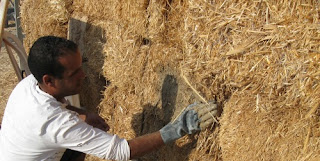
Together with the late architect Yuval Amir, she designed a 9x7 meter (29.5 x 23 foot) straw-and-mud structure for Wadi Na'am, a rambling collection of cinder block-and-tin shacks near the Ramat Hovav hazardous waste dump. An outer enclosure wall, built from adobe-covered tires filled with gravel and garbage, was built to protect the clinic from the Sharqia, or eastern desert wind.
 Not a paradigm shift, but a strong trend
'The pracice of adobe/straw building has a history in Bedouin tradition, and this project reintroduced these sustainable, low-budget techniques. It was an amazing experience that brought hundreds of Jewish Israeli volunteers to unrecognized villages and made them aware of the problems the Bedouins face, and also exposed them to natural building,' she says.
Vital-Baron is keen to point out why Israelis need green building: 'Because we are exhausting our resources on quarrying, transportation and the accompanying air pollution. Construction is a heavy industry. Natural building has many advantages - that's why we're examining materials that are not quarried. A modern house with all the facilities can be built with natural materials, and be just as functional. Between 20 and 30 such houses already exist in Israel.'
In 2005 she went solo, opening one of Israel's first 'green' architecture companies. 'Only Yuval operated in the field of natural building at the time, and there were about five other companies with a declared environmental approach.'
During the latter half of the decade, interest in this unconventional field - and eventually job orders - began to increase. Now she is fully-booked and employs another architect.
'Most people turn to me asking for 'regular' construction or renovation, but with the added value of minimizing the environmental damage. I talk to them about making their homes solar passive, the importance of shade, insulation and lowering water usage.
'We offer the same services as a regular company but with a green emphasis. For example, conducting a thermal analysis of a house helps the owner decide what is worth investing in. The second group is those who want to build with their own hands. They need closer support, often physically on-site,' she explains.
'There are at least five to eight other companies similar to mine now, dealing with natural materials. It's unbelievable - only a few years ago it looked like a distant dream to me, but now everyone seems to be interested. It's too early to talk about a deep-rooted change of attitudes, a paradigm shift, but it's definitely a strong trend - and it's also coming from above.
 Solutions in synch with surroundings
'There's more awareness of energy usage and saving, often the result of local councils and municipalities demanding greater insulation, shading, etc. in building design. It was nice working only with the hard-core environmentalists until now - but it makes me really happy to see official bodies making such demands,' she adds.
Vital-Baron's approach has been adopted by Quasr Al-sir, a neglected, litter-strewn desert shanty near Dimona, home to some 5,000 Bedouins. The rapidly expanding settlement received state recognition in 2006, joining the Abu Basma regional council that unites 11 such villages.
'The regional council has drawn up development plans, with demarcated plots of land, a school, kindergartens and a community center,' Vital-Baron relates. 'Bustan adopted the community center project and I planned it together with local residents - representatives of both the men and the women. It's been an interesting, unprecedented process that will serve as a platform for further development programs. Sustainable development is the way forward for the Bedouins,' she says, adding, 'I took all sorts of techniques that can be done with a local workforce - part of the idea is to train a core group of builders in the village.'
A group of 15, 18-to-30 year-old Bedouins - who would otherwise be unemployed - are working on her projects right now, learning the trade as they go. Earlier this year, they underwent a training course at Kibbutz Lotan in the Arava desert, Israel's 'greenest' community, paid for by Bustan. 'The vision is to organize for them a long training course recognized by the Industry, Trade and Labor Ministry that would give them a professional qualification,' she says.
'We want to set up a community center for the elderly and youngsters of the village,' says Elhwashla, the local council head. 'We intend to start building in the coming months. There's a lack of belief among the Bedouins (the exception being Ahmed Amrani, who has been dubbed 'the green Bedouin') that it is possible, because our economic situation is so bad. But for a low price, we can make it happen. We want to be an example to other Bedouins.'" (source)
In the shade of an expansive mulberry tree at the bottom of her family's rambling garden in leafy Karkur, in northern Israel, Michal Vital-Baron points to a pie chart on her laptop screen. 'You see how much energy is wasted in quarrying, transporting and building with these materials?' she asks.
A group of 15 burly Bedouin men from the southern village of Quasr Al-Sir soak up the data like diligent schoolchildren. They have been bused in from the distant Negev, and want to cram as much knowledge into the day as possible. Minutes earlier, they had returned from a visit to a nearby community garden, full of admiration for the local residents who had transformed a waste plot into a blooming organic vegetable garden.

She also walks her talk. When the time came to renovate the family living room, she chose to rebuild the walls using compacted earth blocks. These are bricks made from highly-pressed soil that contain mineral, rather than organic substances.
Having completed several design courses conducted by Israel's permaculture guru Talia Schneider, Vital-Baron is about to hold her own (third) four-month permaculture design course - one of which was held for 15 Bedouin men and women in the southern city of Beersheba.
'She's opening our eyes'
Blue-eyed and soft-spoken, she somehow manages to penetrate male-dominated mindsets. 'The Bedouins have a lot of respect for me,' she tells ISRAEL21c. 'They have a term jaddah, which means a woman with power. It's mutual - I see in them people from whom I have much to learn: How to accept life when it's hard, without complaining. They are very optimistic people with boundless patience. It's hard to break their spirit. The Bedouin women see me as an example of what a woman - a mother - can achieve.'
Earlier that morning, she had introduced the Bedouin men to the concept of the ecological footprint. 'She's opening our eyes,' exclaims Ibrahim Elhwashla, head of the village council.
'Michal has taught us about green construction methods, heating and cooling of structures, energy consumption and waste reduction - things we didn't think about before.
'We don't have this knowledge - how to build permanent homes,' Elhwashla admits. 'Meeting Michal has introduced us to a different way of thinking, an ecological mindset. We want to strengthen this. Look at the young men - they want to learn. I'm convinced that this is the right way for us - closer to nature. The whole world is beginning to understand the ramifications of everything we do. If God made us from nature, we should protect it.'
Vital-Baron was a professional weaver ('one of the last weavers in Israel - the textile market is dead') for 15 years while raising three children. 'All that's behind me now - the last of my children left the nest two weeks ago.'
After studying interior design at the Hermelin College of Engineering in Netanya, she joined her mother's company, Edith Baron Interior Architecture, in 1995, following a family tradition. 'My grandfather, Zalman Baron, was one of the first designers of Tel Aviv. My father is an engineer and my mother an interior designer. I was a conventional architect who specialized in redesigning the interior of hotels,' she says.
Discovering the Earthships
In 2001, during a trip to the US, she first came across Earthships - sustainable homes made of natural and recycled materials - while working in a Jewish summer camp in Colorado. For three months, she watched how a complete Earthship, designed by green construction pioneer Michael Reynolds was built. She also travelled to Taos, New Mexico, to see up close the Greater World Earthship Community being constructed.
'I took plenty of notes. During this process I came to realize that we can do things naturally, with an added value to the environmental. These houses are pretty, but also practical, sturdy structures. I learned how to do things properly, taking into account both the environment and social factors.'
Upon her return, she completed Israel's first green architecture course, held under the auspices of the Environment Ministry, at the Israel Building Center on Kibbutz Ga'ash. 'The very concept was an urban legend in Israel at that point - something people talked about but had never actually done. The field was still in its infancy here in 2002.'
Vital-Baron focused on 'natural building' technologies, 'but I had no idea what to do with this knowledge at that point. The economy was in recession brought on by the second intifada, and my work at the family business was cut to three or four days a week. This left me with time to do other things.'
The breakthrough came when the NGO Bustan, which promotes sustainable community action among the Bedouins of the Negev desert, contacted her. The proposed project: To build a medical clinic in one of the dozens of Bedouin shanty settlements that dot the Negev, following a High Court decision that 'unrecognized' villages must receive medical services.
Together with the late architect Yuval Amir, she designed a 9x7 meter (29.5 x 23 foot) straw-and-mud structure for Wadi Na'am, a rambling collection of cinder block-and-tin shacks near the Ramat Hovav hazardous waste dump. An outer enclosure wall, built from adobe-covered tires filled with gravel and garbage, was built to protect the clinic from the Sharqia, or eastern desert wind.

'The pracice of adobe/straw building has a history in Bedouin tradition, and this project reintroduced these sustainable, low-budget techniques. It was an amazing experience that brought hundreds of Jewish Israeli volunteers to unrecognized villages and made them aware of the problems the Bedouins face, and also exposed them to natural building,' she says.
Vital-Baron is keen to point out why Israelis need green building: 'Because we are exhausting our resources on quarrying, transportation and the accompanying air pollution. Construction is a heavy industry. Natural building has many advantages - that's why we're examining materials that are not quarried. A modern house with all the facilities can be built with natural materials, and be just as functional. Between 20 and 30 such houses already exist in Israel.'
In 2005 she went solo, opening one of Israel's first 'green' architecture companies. 'Only Yuval operated in the field of natural building at the time, and there were about five other companies with a declared environmental approach.'
During the latter half of the decade, interest in this unconventional field - and eventually job orders - began to increase. Now she is fully-booked and employs another architect.
'Most people turn to me asking for 'regular' construction or renovation, but with the added value of minimizing the environmental damage. I talk to them about making their homes solar passive, the importance of shade, insulation and lowering water usage.
'We offer the same services as a regular company but with a green emphasis. For example, conducting a thermal analysis of a house helps the owner decide what is worth investing in. The second group is those who want to build with their own hands. They need closer support, often physically on-site,' she explains.
'There are at least five to eight other companies similar to mine now, dealing with natural materials. It's unbelievable - only a few years ago it looked like a distant dream to me, but now everyone seems to be interested. It's too early to talk about a deep-rooted change of attitudes, a paradigm shift, but it's definitely a strong trend - and it's also coming from above.

'There's more awareness of energy usage and saving, often the result of local councils and municipalities demanding greater insulation, shading, etc. in building design. It was nice working only with the hard-core environmentalists until now - but it makes me really happy to see official bodies making such demands,' she adds.
Vital-Baron's approach has been adopted by Quasr Al-sir, a neglected, litter-strewn desert shanty near Dimona, home to some 5,000 Bedouins. The rapidly expanding settlement received state recognition in 2006, joining the Abu Basma regional council that unites 11 such villages.
'The regional council has drawn up development plans, with demarcated plots of land, a school, kindergartens and a community center,' Vital-Baron relates. 'Bustan adopted the community center project and I planned it together with local residents - representatives of both the men and the women. It's been an interesting, unprecedented process that will serve as a platform for further development programs. Sustainable development is the way forward for the Bedouins,' she says, adding, 'I took all sorts of techniques that can be done with a local workforce - part of the idea is to train a core group of builders in the village.'
A group of 15, 18-to-30 year-old Bedouins - who would otherwise be unemployed - are working on her projects right now, learning the trade as they go. Earlier this year, they underwent a training course at Kibbutz Lotan in the Arava desert, Israel's 'greenest' community, paid for by Bustan. 'The vision is to organize for them a long training course recognized by the Industry, Trade and Labor Ministry that would give them a professional qualification,' she says.
'We want to set up a community center for the elderly and youngsters of the village,' says Elhwashla, the local council head. 'We intend to start building in the coming months. There's a lack of belief among the Bedouins (the exception being Ahmed Amrani, who has been dubbed 'the green Bedouin') that it is possible, because our economic situation is so bad. But for a low price, we can make it happen. We want to be an example to other Bedouins.'" (source)
(NEWS) 6 African Migrants Killed By Bedouins While Trying To Enter Israel
"Gun battle erupts between Africans and Beduin smugglers over fees.
A gun battle between African migrants and Bedouin traffickers demanding more money to take them to Israel killed four people in Egypt's Sinai Desert, security officials said Saturday.
The traffickers had tied up around 300 of the illegal migrants, but several managed to escape and grab weapons from their captors, setting off Friday's fighting, the two officials said, quoting from witness statements. Around 100 of the migrants fled, they said."
A gun battle between African migrants and Bedouin traffickers demanding more money to take them to Israel killed four people in Egypt's Sinai Desert, security officials said Saturday.
The traffickers had tied up around 300 of the illegal migrants, but several managed to escape and grab weapons from their captors, setting off Friday's fighting, the two officials said, quoting from witness statements. Around 100 of the migrants fled, they said."
Subscribe to:
Posts (Atom)


